







Evolutionary AI Design
Researchers have pioneered a sophisticated artificial intelligence system that ingenibly mimics the lengthy process of natural evolution, but compresses
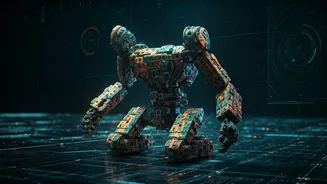
it into an astonishingly short timeframe – mere seconds. This AI is trained on extensive datasets, enabling it to rapidly generate intricate robot designs. These designs are not static; they are built with a modular, interconnected structure akin to LEGO bricks. This fundamental design allows the robots to dynamically reconfigure themselves and maintain operational capability even when parts of their structure are compromised or entirely lost. This significant advancement opens up new possibilities for applications demanding robust and flexible robotic systems, including the development of advanced prosthetics, critical disaster response units, and sophisticated systems for space exploration where reliability under adverse conditions is paramount.
Modular Robotic Building Blocks
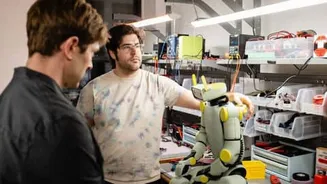
The robots developed by Northwestern University researchers are characterized by their unique modularity, resembling a collection of building blocks that can be assembled and reassembled. These 'LEGO-like' robots feature multiple attachable pieces or 'limbs,' which can be connected to a single robot. This configuration allows for substantial alterations to the robot's shape and its method of locomotion. Crucially, these modifications do not impede the robot's ability to advance across varied and unstructured landscapes. In contrast to many conventional mobile robots, which possess rigid, fixed structures and typically adopt familiar bipedal or quadrupedal forms, these reconfigurable 'metamachines' can adopt a vastly wider array of configurations, pushing the boundaries of robotic mobility and form.
Adapting to Adversity
Despite potentially unconventional limb arrangements, these robots exhibit an exceptional aptitude for self-correction and continued movement when faced with obstacles or difficulties. They possess an impressive capacity to right themselves even if completely overturned, demonstrating a remarkable resilience. Furthermore, their agility allows them to surmount impediments by leaping over them and even perform complex aerial maneuvers. The core of these extraordinary capabilities lies in the team's advanced AI, which employs an evolutionary algorithm that effectively simulates the principles of natural selection. Initially, this simulation operated purely in a digital environment, confined to software. The AI's objective was to devise novel body configurations using the robot's modular components, aiming to discover the most efficient designs for traversing diverse terrains.
Simulating Natural Selection
The process begins with the AI exploring a virtual realm, extensively testing various robot configurations. Designs deemed less effective are systematically discarded, a process mirroring the 'survival of the fittest' principle in evolution. After this virtual trial-and-error phase, the research team physically constructed the most promising three-, four-, and five-legged designs that the AI had identified. These assembled robots were then put to the test in real-world conditions, successfully navigating terrains composed of gravel, grass, tree roots, leaves, sand, mud, and uneven bricks without any need for human intervention or experiencing interruptions. A particularly striking demonstration of their advanced design was observed when the metamachines encountered damage. The researchers conducted simulations where different configurations suffered breaks or lost entire limbs, yet the remaining modules dynamically adapted, enabling the robots to continue their locomotion without cessation.