




Martian Sunrises and Sunsets
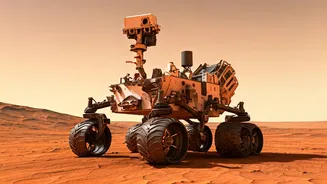
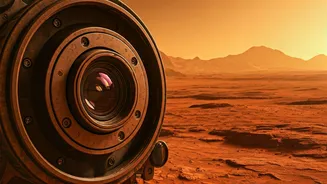
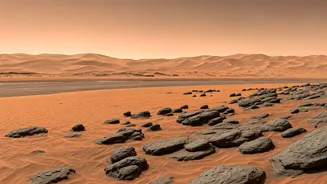
NASA's Curiosity rover, a technological marvel, has sent back a breathtaking holiday postcard showcasing a Martian sunrise and sunset. These images provide
a vivid visual experience of the Red Planet's atmospheric conditions. The data gathered from these observations help scientists understand the properties of dust and ice particles that influence the scattering of sunlight. This allows researchers to study the Martian atmosphere and gain a better understanding of climate change processes. The captured visuals demonstrate how light interacts with the Martian atmosphere, offering scientists valuable insights into its composition and behavior. Through these stunning images, scientists are able to improve existing models and plan for future missions to the Red Planet. Furthermore, studying these images also allows the scientists to understand the potential of a future human mission to Mars.
Mapping the Cosmos
The SPHEREx telescope, constructed by NASA, has completed its first full-sky cosmic map, providing unparalleled insights into the structure and evolution of the universe. This remarkable map unveils billions of galaxies, mapping their locations and distances with incredible precision. Scientists are now equipped to study the distribution of dark matter and dark energy, the invisible components of the cosmos. The data collected by SPHEREx will aid scientists in understanding the early universe by mapping various wavelengths of light from distant galaxies. As a result, researchers are better able to observe the expansion of the universe and trace the formation of the first galaxies. The detailed map acts as a valuable resource for future astronomical research, allowing researchers to study various cosmological phenomena and providing a clearer vision of the universe's past, present, and future.
Exoplanet Atmospheres Examined
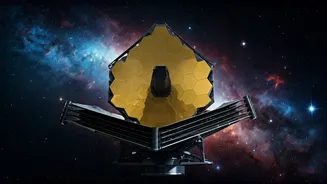
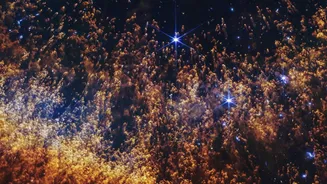
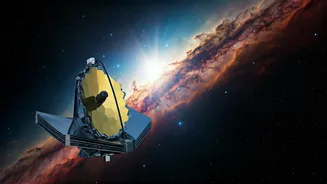
The James Webb Space Telescope (JWST) has made a groundbreaking discovery, revealing the powerful winds and dense atmosphere of the exoplanet TOI-561b. Located relatively close to Earth, this rocky world offers a unique opportunity to study the atmospheres of planets beyond our solar system. The data gathered sheds light on the atmospheric composition, including the presence of various gases and weather patterns. By using advanced spectroscopic methods, JWST detects the light that filters through these atmospheres, offering scientists clues about their chemical makeups. This provides researchers the chance to understand the processes that drive atmospheric dynamics. Further, understanding of this exoplanet could provide clues about whether or not it may be inhabitable. The revelations from JWST help in better understanding the diverse atmospheres of exoplanets and the potential for life beyond Earth.
Galaxy Collision Unveiled
The Chandra X-ray Observatory spotted a spectacular event: the Champagne Cluster, formed by a massive galaxy collision. The image shows the energetic processes at play, from the formation of new stars to the creation of supermassive black holes. The data gathered helps scientists better understand the dynamics of galaxy mergers. These interactions trigger the formation of new stars and influence the evolution of galaxies over cosmic timescales. Researchers can study the interactions between these galaxies by observing the X-ray emissions from hot gas and the distribution of dark matter. The study provides important insights into galaxy evolution, the formation of cosmic structures, and the behavior of supermassive black holes. Such observations allow scientists to enhance the models of the formation of galaxies.