






AI's Evolving Frontier
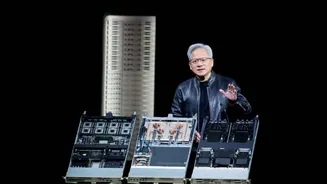
The annual Nvidia GTC conference has become a pivotal platform for showcasing the company's latest strides in artificial intelligence. CEO Jensen Huang's
keynote is anticipated to reveal a comprehensive roadmap of innovations, spanning from advanced chip architectures to the burgeoning field of AI agents and even physical robotics. This year's event carries significant weight as it occurs amidst a rapidly intensifying competitive environment, with other tech giants and even some of Nvidia's key clients developing their own specialized hardware. Investors will be keenly observing for assurances that Nvidia's substantial investments in the AI ecosystem are yielding the expected returns, particularly in areas like AI inference, agent orchestration, and the infrastructure that powers these complex systems. The shift towards AI agents, capable of performing tasks autonomously across various applications, signifies a maturation of AI technology, moving beyond purely training-focused workloads.
Navigating Market Dynamics
Nvidia's chips are foundational to hundreds of billions of dollars invested globally in data centers. However, the company faces increasing pressure from rivals and custom-designed silicon from its own major customers. The AI market is transforming, with a notable shift from the intensive data processing required for training AI models to the widespread application of AI for 'inference' – the process of using trained models to perform tasks. While inference tasks can be handled by various types of processors, including those developed in-house by companies like OpenAI and Meta, Nvidia is strategically positioning itself to maintain its dominance. Analysts predict that while Nvidia currently holds a commanding market share, an increasing number of customers will begin to deploy their own custom-designed integrated circuits (ASICs) starting around 2027, especially for inference workloads, due to their potential for greater efficiency in specific applications.
Strategic Acquisitions and Integration
In a move to bolster its capabilities, Nvidia acquired Groq, a startup specializing in high-speed, cost-effective inference computing, for $17 billion. The company plans to demonstrate at GTC how Groq's advanced AI technology can be seamlessly integrated into Nvidia's existing CUDA software platform. This integration is expected to yield new product lines, such as servers that combine Groq's specialized chips with Nvidia's networking technologies, aiming to deliver a powerful and economically viable solution for AI workloads. This strategic integration highlights Nvidia's commitment to enhancing its offerings and addressing the evolving demands of the AI market, particularly in the crucial area of inference performance.
Emerging Competitive Threats
Beyond specialized AI accelerators, central processing units (CPUs), traditionally dominated by companies like Intel and AMD, are also re-emerging as significant players in the AI landscape. While graphics processing units (GPUs) have been the primary focus for AI computation in recent years, CPUs are regaining prominence, particularly with the rise of agentic AI. The bottleneck in managing multiple AI agents performing tasks on behalf of users often lies in the 'orchestration' layer, which is heavily reliant on CPU processing power. Analysts anticipate Nvidia will showcase servers that leverage its own CPUs, reflecting a strategy to address this crucial aspect of AI deployment and maintain a comprehensive solution for complex AI systems.
The Future of Connectivity
Nvidia has also invested significantly, with $2 billion in each of Lumentum and Coherent, companies that manufacture lasers essential for high-speed data transmission between chips. This investment points towards the strategic importance of co-packaged optics, a technology that utilizes lasers to send information as light beams, thereby speeding up internal chip communication within massive data centers. While this technology holds immense potential for more efficient connections among Nvidia's vast AI clusters, a key challenge remains scaling production to meet the sheer volume of chips Nvidia sells annually and making it economically feasible for widespread deployment. The company is expected to position co-packaged optics as a critical component for future AI infrastructure, emphasizing its role in enhancing performance and efficiency.