






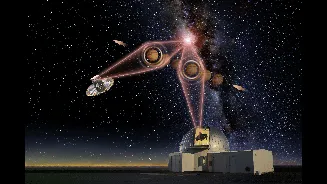

Hubble's New Vantage
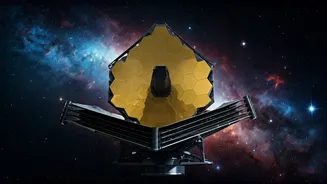
The Hubble Telescope's capacity to observe the cosmos has resulted in significant breakthroughs in astronomy. Its latest achievement involves identifying
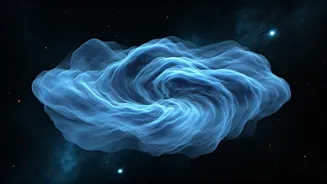
a starless dark matter cloud, an unprecedented opportunity for scientists. The study of dark matter, a mysterious substance thought to constitute approximately 85% of the universe's mass, has been a significant field of study. The telescope's instruments allow the collection of faint signals. This enables scientists to analyze the cloud and better understand dark matter's characteristics, distribution, and how it interacts with the visible matter. The discovery marks a crucial milestone in our understanding of the universe, offering clues about its composition, structure, and evolution. This event is vital for ongoing attempts to understand the cosmos's greatest mysteries, as the implications of this discovery could potentially alter our understanding of the universe.
Dark Matter Unveiled
Dark matter is considered to be one of the universe's greatest mysteries. It is invisible, so its presence is deduced from its gravitational effects on visible matter, such as galaxies and stars. The Hubble Telescope's detection of a starless dark matter cloud gives scientists direct access to study this intriguing substance. This allows a deeper investigation into its properties. By studying the cloud, researchers can refine theoretical models. The findings will help to determine if current theories about dark matter are accurate. The cloud provides a special opportunity to study dark matter in isolation, unaffected by the complex interactions found in other regions of space. This isolation allows for the most precise analysis. Astronomers are now able to investigate the structure and distribution of this cloud. This is a crucial step towards understanding the bigger picture: the role dark matter plays in the universe's formation and evolution.
Significance of Discovery
The discovery of a starless dark matter cloud has significant implications for astrophysics. This discovery opens a window into the dark universe. The research provides a rare chance to see how dark matter behaves without the complications of stars and galaxies. The findings will help scientists understand how dark matter clumps together. This will help them learn about the formation of the large-scale structures in the universe, such as galaxies and galaxy clusters. This observation also assists in studying the nature of dark matter. Different theories suggest that dark matter is composed of particles, but this finding might provide evidence for different models. The Hubble Telescope's observations of the dark matter cloud is vital for researchers as they work to refine our models of the cosmos, providing a clearer understanding of the universe's composition and evolution.
Future Research Avenues
This discovery by the Hubble Telescope paves the path for several future studies. Scientists will likely use the data to perform in-depth analyses of the dark matter cloud. These investigations will focus on its internal structure, density variations, and gravitational impacts. Future research may involve comparing the observed cloud properties with predictions from various dark matter models. Further, the discovery will lead to investigations using advanced simulation techniques. Researchers will develop simulations to explore the cloud's formation and evolution. This will enable scientists to create a more comprehensive picture. The Hubble Telescope's findings set the stage for investigations. This will promote a deeper exploration into dark matter and its function within the universe. The discoveries will help with future telescopes and observing missions.