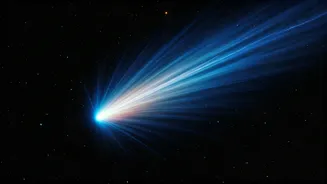








Comet's Earthly Encounter
Comet 3I/ATLAS, an interstellar visitor, recently reached its closest point to Earth, providing a spectacular view for stargazers. Its journey offered
a unique opportunity for observation and analysis, allowing scientists to study its composition and trajectory. This celestial event also reminded us of the vastness of space and the transient nature of comets. The comet's journey, though fleeting, serves as a significant reminder of the dynamic nature of our solar system and the ongoing exploration of celestial bodies. The event stirred the curiosity of both amateur and professional astronomers, all eager to catch a glimpse of this icy wanderer as it traversed the night sky. The comet’s path, meticulously tracked by scientists, determined the best times and locations for optimal viewing, ensuring that as many people as possible could share in the experience.
JWST's Revelations
The James Webb Space Telescope (JWST) continues to astound scientists with its unparalleled capabilities, consistently delivering groundbreaking discoveries. Its high-resolution images and spectroscopic data are fundamentally altering our understanding of the universe. The telescope's findings include mapping exoplanet atmospheres, possibly identifying a 'doomed' star, and potentially spotting the earliest-known galaxy. These discoveries provide unprecedented insight into the formation of galaxies, the composition of planetary atmospheres, and the potential for life beyond Earth. From identifying an all-carbon atmosphere on a planet orbiting a 'black widow' star to capturing the first 3D map of an alien planet's atmosphere, the JWST continues to push the boundaries of scientific understanding. The data collected is also enabling astronomers to study the atmospheres of distant planets in unprecedented detail.
Exoplanet Explorations
The hunt for planets outside our solar system has yielded remarkable results, with the discovery of thousands of exoplanets, like a fifth planet orbiting a nearby star potentially within its habitable zone. These exoplanet discoveries continue to fuel the search for potentially habitable worlds. This has raised hopes for extraterrestrial life, and sparked new questions. The JWST's observations have also revealed a 'broiling hell planet' with an atmosphere that shouldn't exist, which adds further mystery to the field of astronomy. Furthermore, the discovery of a 'disappearing' planet in our neighboring star system, which could have a habitable moon, further underlines the diversity and complexity of exoplanetary systems. Scientists are using advanced tools and techniques to identify and analyze these planets. The findings from these exoplanets are providing unprecedented insight into the variety of planetary systems and the conditions that might support life beyond our planet.
Celestial Events Unveiled
Recent observations have revealed extraordinary celestial events, like an 'unprecedented protoplanet collision' observed around the 'Eye of Sauron' star system, just 25 light-years from Earth. Furthermore, scientists have spotted a 'runaway' planet that's acting like a star, consuming vast amounts of material. These exceptional events provide critical data on planetary formation, stellar evolution, and the dynamics of space. These events often provide crucial insights into the processes shaping the universe, giving astronomers and scientists new opportunities to refine their models. These observations, combined with data from the JWST, continue to offer unparalleled insight into the formation and evolution of celestial objects. The study of these rare events is key to understanding the full scope of space's complexity.
Historical Context & Data
The scientific community continues to advance in their understanding of the universe. This has been supported by various important events like the identification of the first known planet around a sunlike star back in November 1, 1995. Scientists have found over 6,000 planets beyond our solar system, with ongoing analysis. This underscores the continuous nature of astronomical research and the cumulative progress made. The historical milestones provide a valuable context for appreciating current discoveries and the pace of advancement in the field. These advancements, made possible by dedicated teams and cutting-edge technology, have continually broadened our knowledge of the cosmos. By studying past and present discoveries, researchers are capable of developing better models for how the universe functions and evolve.