
Hairs that Hear
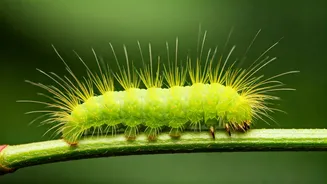
The research into caterpillar hearing has highlighted an exceptional sensory ability. Caterpillars, it turns out, don't rely on ears like humans do. Instead,
they pick up sounds using tiny hairs covering their bodies. These hairs function as sensitive receivers, translating sound vibrations into signals their brains can understand. This unique adaptation allows caterpillars to navigate and respond to their environment in a manner previously unknown. This intricate sensory system showcases nature's ingenious solutions to the challenges of survival and adaptation in the natural world, giving inspiration to future technologies.
Microphone Inspiration
The revelation of caterpillar hearing has significant implications for technology, specifically in microphone design. The sensitivity and efficiency of the caterpillars' hair-based hearing could provide a model for creating more advanced microphones. Engineers could potentially mimic the structure and function of these sensory hairs to build microphones that are better at capturing subtle sounds or functioning in challenging environments. This offers the potential for devices with enhanced audio clarity, smaller sizes, and improved performance in various applications, from consumer electronics to medical devices. This research offers a bridge between the natural world and technological innovation.
Body Hair Details
Caterpillar's body hairs, although small, are crucial to their ability to hear. These hairs vary in size and distribution across their bodies, each with a specific role in sound detection. The arrangement of the hairs, as well as their individual characteristics, enhances their ability to capture vibrations. The research has focused on understanding the precise mechanisms by which these hairs convert sound waves into electrical signals, allowing scientists to uncover the subtle intricacies of caterpillar hearing. The understanding of the body hair structure and function will be key to replicating the feature in microphones.
Broader Implications Explored
The findings go beyond microphone design, as the study contributes to the broader field of sensory biology. The discovery prompts scientists to reconsider our understanding of how various species perceive their environments. Researchers are looking at the similarities and differences in auditory systems across various creatures. The understanding can pave the way for creating new tools for studying animal behavior and interactions. By gaining insights from these natural sensors, there can be a broader understanding of how these natural systems can inspire innovative solutions.
Future Research Awaits
Future research is expected to delve deeper into the specifics of caterpillar hearing. Scientists will want to analyze the frequency range and sensitivity of the hairs. Studying how the caterpillars process these auditory signals will be important. Also, the study will analyze different types of caterpillars to find any variations in their hearing abilities. By investigating these aspects, researchers hope to improve existing technologies and unlock further mysteries of the natural world. This research provides a promising base for developing creative and innovative technologies.