



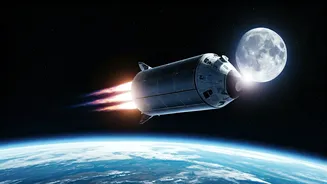
Satellite's Impending Descent
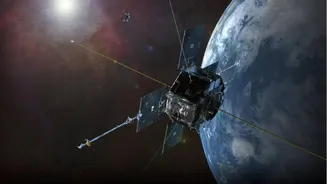
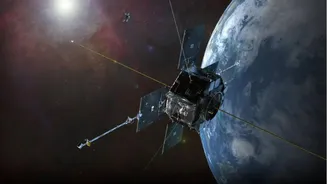
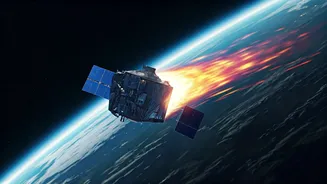
Get ready for a cosmic spectacle as NASA's Van Allen Probe A, a substantial satellite weighing approximately 1,323 pounds, is predicted to make its fiery
return through Earth's atmosphere. This event, scheduled for March 10, marks the end of a remarkable nearly 14-year journey since its launch on August 30, 2012. The U.S. Space Force has been closely monitoring its trajectory, projecting the re-entry for around 7:45 p.m. EDT on March 10, which translates to 5:15 a.m. IST on March 11. While this is the latest prediction, it comes with a potential margin of error of up to 24 hours, emphasizing the dynamic nature of orbital mechanics. NASA assures the public that the likelihood of any debris posing a threat to individuals on the ground is exceedingly low, estimated at about 1 in 4,200. The agency, in conjunction with the Space Force, will continue to provide updated tracking information as the satellite approaches its final descent.
Mission to Understand Radiation
The Van Allen Probe A was not just any satellite; it was a crucial component of a twin-probe mission, alongside its counterpart Van Allen Probe B, dedicated to unraveling the mysteries of Earth's Van Allen radiation belts. These belts, encompassing Earth like invisible doughnuts, are regions of charged particles held in place by our planet's magnetic field. From 2012 to 2019, these probes ventured directly into these harsh environments, a feat few missions undertake, to meticulously study how these energetic particles accumulate and dissipate. The significance of these belts cannot be overstated; they act as a vital shield, deflecting harmful cosmic radiation, solar storms, and the constant solar wind, thereby safeguarding both our technological infrastructure and the safety of astronauts venturing into space. The original mission was designed for a mere two years, but the probes' resilience and the invaluable data they collected extended their operational life significantly, pushing the boundaries of our understanding of space weather.
Discovery and Unexpected Re-entry
During its extensive operational period, Van Allen Probe A achieved significant scientific breakthroughs, most notably identifying a fleeting third radiation belt that materializes during periods of intense solar activity. This discovery was a testament to the probe's ability to function within the perilous radiation belts, a region typically avoided by most spacecraft. However, the satellite's mission was concluded in 2019 when both Van Allen Probes depleted their fuel reserves, rendering them unable to maintain their orientation towards the Sun for power. Interestingly, earlier predictions suggested the satellite would remain in orbit until 2034. The accelerated re-entry is attributed to the current solar cycle, which has proven to be far more active than anticipated, with the Sun reaching its peak activity, or solar maximum, in 2024. This heightened solar activity has increased atmospheric drag on the satellite, causing it to descend more rapidly than previously calculated and leading to its earlier-than-expected return to Earth.
Legacy and Future Implications
Even as Van Allen Probe A begins its final journey, the wealth of data it meticulously collected continues to be an indispensable resource for the scientific community. This information is pivotal for enhancing our comprehension of space weather phenomena and their wide-ranging impacts. These impacts extend from the functionality of satellites and the well-being of astronauts to the reliability of terrestrial systems such as global communication networks, navigation services, and power grids. Scientists are diligently poring over the archived data, aiming to refine predictive models for solar activity and to better anticipate potential hazards that could affect our increasingly technology-dependent world. Meanwhile, its twin, Van Allen Probe B, is anticipated to continue its orbital duties and is not expected to re-enter Earth's atmosphere until sometime after 2030, providing further valuable insights.