




New Glenn's Drone Ship Landing
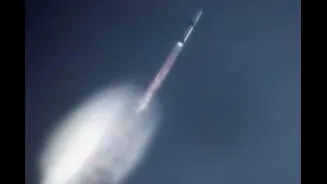
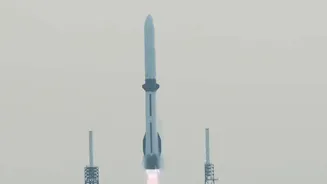
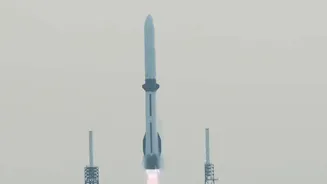
Blue Origin, the space venture spearheaded by Jeff Bezos, recently marked a significant advancement in its reusable rocket program. On April 19th, the New
Glenn rocket was launched from its Florida facility, utilizing the same first-stage booster that powered its prior mission, NG-2. This successful launch and subsequent recovery of the booster through a vertical landing on a vessel positioned in the Atlantic Ocean underscores the company's commitment to developing more cost-effective orbital launch capabilities. While the mission experienced a partial setback with an off-nominal orbit for a direct-to-cellphone satellite payload, the booster's recovery was a notable success. Bezos himself shared a video of this crucial first-stage landing via an X post, showcasing the impressive feat of engineering.
Musk's Congratulatory Nod
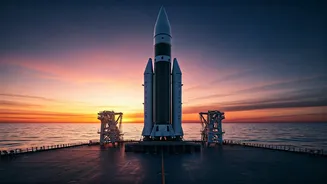
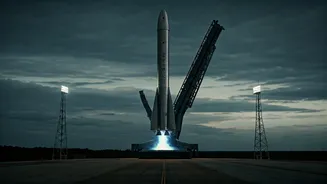
The public acknowledgment of this accomplishment came from an unexpected source: Elon Musk, CEO of SpaceX, a company often seen as a primary rival to Blue Origin. Musk responded to Bezos's post with a simple yet significant "Congrats," acknowledging the New Glenn booster's successful vertical landing on the drone ship. This gesture stands in contrast to the ongoing regulatory friction between their respective companies. Earlier in the month, Musk had also offered a brief compliment on a nighttime photograph of the New Glenn rocket on its launchpad, describing it as "Looks dood." These instances of communication highlight a complex relationship, where intense competition coexists with a shared passion for space exploration advancements.
Regulatory Jabs Exchanged
The congratulations between Musk and Bezos occur against a backdrop of significant regulatory contention between Amazon (Bezos's primary company) and SpaceX. Both entities have been actively filing complaint letters with the US Federal Communications Commission (FCC). SpaceX recently submitted a formal letter addressing Amazon's objection to SpaceX's ambitious proposal for a constellation of 1 million satellites intended for orbiting data centers. SpaceX's argument points out that if Amazon's criticisms are to be applied, they should also be considered for Blue Origin's own plans, which include an application for 51,600 AI satellites. This maneuver by SpaceX appears to be a strategic move to ensure consistent regulatory standards are applied across all major players in the satellite deployment arena.
AI Demand Drives Satellite Plans
Blue Origin's proposal to deploy up to 51,600 satellites for data center purposes is framed by the company as a response to the burgeoning demand for artificial intelligence (AI) workloads. In their filing, Blue Origin argues that these orbiting servers offer a complementary layer to terrestrial infrastructure, operating independently of Earth-bound limitations. The explosive growth in AI, machine learning, and cloud computing has created an unprecedented need for data center capacity, a need that terrestrial facilities are increasingly struggling to meet due to scaling challenges. By proposing a 'new compute tier,' Blue Origin aims to address these limitations and capitalize on the evolving technological landscape, positioning satellites as a crucial component for future AI development and deployment.