





AI's Martian Navigation Debut
In a monumental stride for space exploration, NASA's Perseverance rover has successfully completed its first drives on another planet, guided entirely
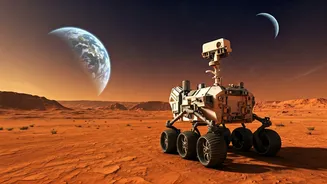
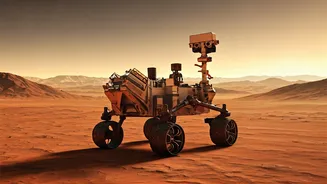
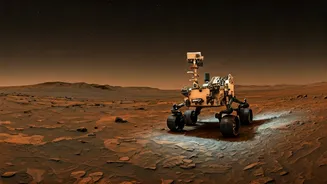
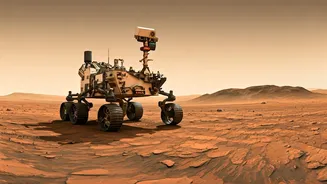
by artificial intelligence. This pioneering demonstration, which took place on December 8 and 10, saw generative AI take the reins for route planning, a task traditionally handled by human operators. The system analyzed existing data and images, much like human planners, to chart a safe course across the challenging Martian landscape of Jezero Crater's rim. This advancement signifies a significant leap towards greater autonomy for robotic missions, enhancing their efficiency and scientific return, especially as missions venture further from Earth. The ability for rovers to navigate complex environments independently is crucial for future endeavors, allowing them to respond dynamically to unexpected terrain and maximize the data they collect without constant human intervention.
Vision AI Steering the Way
The breakthrough was made possible by employing a sophisticated form of generative artificial intelligence known as vision-language models. These advanced systems were trained on extensive datasets from JPL's surface missions, meticulously processing the same visual and sensor information that human route planners normally utilize. By analyzing this data, the AI was capable of autonomously generating precise waypoints – crucial fixed locations where the rover receives new navigational commands. This allows Perseverance to expertly maneuver through difficult Martian terrain. The entire operation was coordinated from JPL's Rover Operations Center, in collaboration with Anthropic, leveraging their Claude AI models to facilitate the complex decision-making process for the rover's journey.
The Mars Driving Conundrum
Navigating Mars presents unique and formidable challenges, primarily due to the immense distance between Earth and the Red Planet, which averages about 140 million miles (225 million kilometers). This vast separation introduces significant communication delays, rendering real-time remote control, often referred to as 'joy-sticking,' virtually impossible. For decades, human rover drivers have meticulously planned routes in advance, a painstaking process involving the study of terrain images and system data to design paths composed of waypoints. These waypoints are typically spaced no more than 330 feet (100 meters) apart to mitigate risks associated with hazards like steep slopes or unstable ground. Once finalized, these intricate routes are transmitted via NASA's Deep Space Network, and the rover then executes the commands autonomously.
Generative AI Takes Command
During specific Martian days, or 'sols,' of the Perseverance mission (Martian days 1,707 and 1,709), the responsibility for route planning was fully delegated to the generative AI system. This system analyzed exceptionally detailed orbital imagery captured by the HiRISE camera on NASA's Mars Reconnaissance Orbiter, alongside crucial terrain slope data derived from comprehensive digital elevation models. By identifying significant surface features such as bedrock formations, rocky outcrops, hazardous boulder fields, and sand ripples, the AI was able to construct a continuous and optimized driving route, complete with all necessary waypoints. Before these AI-generated instructions were transmitted to Mars, they underwent rigorous testing on JPL's 'digital twin' – a virtual replica of the rover. This verification process involved scrutinizing over 500,000 telemetry variables to guarantee complete compatibility with the rover's operational flight software, ensuring a safe and successful execution of the autonomous drive.
Future of Exploration Redefined
The successful integration of generative AI into rover navigation heralds a transformative period for future space exploration. According to Vandi Verma, a space roboticist at JPL, the fundamental capabilities of generative AI are demonstrating immense potential in streamlining key aspects of autonomous off-planet driving, including perception (identifying terrain features), localization (knowing the rover's precise position), and planning and control (determining and executing the safest path). This advancement paves the way for surface rovers to undertake much longer drives, potentially spanning kilometers, with significantly reduced operator workload. Furthermore, these intelligent systems will be empowered to autonomously identify and flag scientifically interesting surface features by analyzing vast quantities of rover imagery. Matt Wallace, manager of JPL’s Exploration Systems Office, envisions a future where intelligent systems, trained with the collective expertise of NASA engineers, scientists, and astronauts, are deployed not only on Earth but also in edge applications on rovers, helicopters, and drones. This interconnected intelligence is precisely what is needed to establish the foundational infrastructure for a sustained human presence on the Moon and to propel humanity's journey to Mars and beyond.