






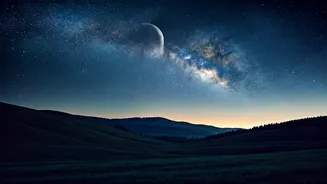
Dark Stars Unveiled
Dark stars are theoretical celestial bodies that may have existed in the early universe. Unlike regular stars that burn through nuclear fusion, these stars would
be powered by the annihilation of dark matter particles within them. The concept proposes that dark matter, a mysterious substance thought to make up a significant portion of the universe's mass, could coalesce in the core of these stars. When dark matter particles collide, they would annihilate each other, generating a burst of energy that would cause the star to shine brightly. The characteristics of these stars are currently explored using complex models and simulations, predicting that they would be enormous and could outshine even the brightest stars known today.
Early Universe Insights
One of the most profound mysteries JWST seeks to unravel is the early universe: the period soon after the Big Bang when the first stars and galaxies formed. Dark stars present a possible solution. They could have been the first luminous objects in the cosmos. Because they could produce enormous amounts of ultraviolet and optical light, dark stars may have played a critical role in 'reionizing' the universe, a process by which the neutral hydrogen that filled the early universe was ionized. These stars could have helped create the first galaxies, which are now observed by JWST. If dark stars indeed populated the early universe, JWST's instruments may be able to detect specific radiation signatures and the light from these long-gone objects.
Black Hole Origins
Another cosmic enigma is the origin of supermassive black holes found at the centers of most galaxies. These black holes are extraordinarily massive, containing millions or even billions of times the mass of the Sun, and their formation process remains largely unknown. One hypothesis suggests that dark stars could have played a key role. Due to their immense size and extreme luminosity, dark stars could have rapidly accumulated mass. As a consequence, they could have collapsed into black holes. If dark stars were prevalent, they may have provided the 'seeds' that later grew into the supermassive black holes. JWST, with its advanced capabilities, will be able to search for evidence of these early black holes, which may shed light on the dark stars.
Lithium Abundance Puzzle
The abundance of lithium in the universe presents a significant discrepancy between theoretical predictions and actual observations. Standard cosmological models predict a much higher amount of lithium than is found in the oldest stars. Dark stars potentially offer a way to solve this mystery. The annihilation of dark matter particles within dark stars could have produced a significant amount of lithium. If dark stars contributed to lithium creation in the early universe, it could explain the lower-than-expected levels that astronomers are currently observing. JWST can look for the specific spectral signatures associated with lithium, in the hopes that this can help with the discovery of the amount created by these mysterious dark stars.
JWST’s Role
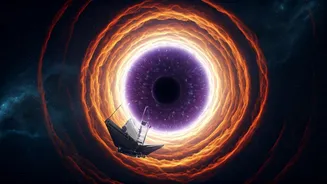
The James Webb Space Telescope (JWST) is the crucial instrument for investigating dark stars. The telescope’s powerful infrared capabilities enable it to peer through dust clouds, allowing it to observe the early universe and detect the faint light of distant objects. If dark stars are present, JWST can use its instruments to search for specific radiation signatures. Scientists can search for the patterns in light that would be produced by dark matter annihilation or look for the presence of unusual elements. It could provide images of previously unseen objects in the universe. The telescope's capabilities are vital to confirm the presence of dark stars, solve the cosmic puzzles, and help understand the very origins of the universe.