




Beyond Chatbots
In the rapidly evolving landscape of artificial intelligence, the spotlight has often been on generative AI models such as OpenAI's ChatGPT, Google's Gemini,
and Anthropic's Claude. These sophisticated systems excel at tasks like composing creative text, engaging in natural conversations, and producing striking imagery. However, Nvidia has recently unveiled a fundamentally different kind of AI model, one that diverges significantly from the capabilities of these popular generative tools. This new innovation is not geared towards creating content or assisting with everyday queries. Instead, it serves a unique and advanced purpose, marking a new direction in AI development and application for highly specialized computational tasks.
Quantum's New OS
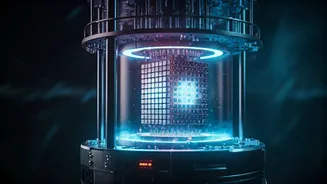
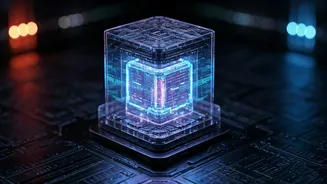
Nvidia's Ising AI models represent a pioneering family of open-source quantum artificial intelligence solutions. Unlike their counterparts designed for conversational AI, these models are engineered to function as the essential "operating system" for the next wave of quantum supercomputers. Their core purpose is to comprehend and manage the incredibly intricate and delicate physics governing quantum bits, or "qubits." Quantum computers, while possessing immense power, are notoriously challenging to control and maintain. They demand continuous "calibration" to ensure accuracy and are prone to frequent errors. This is precisely where Nvidia's Ising AI intervenes. Drawing its name from a mathematical framework used to study physical systems, the model provides the crucial tools needed for real-time error correction. As Nvidia's founder and CEO, Jensen Huang, stated, "AI is essential to making quantum computing practical. With Ising, AI becomes the control plane—the operating system of quantum machines."
Ising vs. Generative AI
The fundamental distinction between Nvidia's Ising AI and generative models like ChatGPT lies in their primary functions and how they process data. While a chatbot operates by predicting the subsequent word in a sequence to generate coherent text, Ising is designed to predict and rectify errors within a quantum processor. This specialized capability makes the Ising Decoding models significantly more performant, boasting up to 2.5 times greater speed and 3 times improved accuracy compared to existing industry benchmarks. Where chatbots might require several seconds for complex computations, Ising is optimized for instantaneous "real-time" processing, a critical requirement to prevent quantum computers from faltering or crashing. This focus on immediate error management and system stability is what sets Ising apart.
Calibration and Decoding
Nvidia's latest release encompasses two distinct types of Ising models, each addressing critical aspects of quantum computing operation. The "Ising Calibration" model functions as a sophisticated "vision language" system. It meticulously analyzes measurements emanating from quantum processors, thereby automating the complex maintenance procedures required to keep these machines running optimally. Nvidia reports that this capability can drastically reduce the initial setup time for a quantum computer, transforming a process that could take several days into one that can be accomplished in mere hours. Complementing this is "Ising Decoding," a suite of specialized neural networks that act as an advanced digital repair crew. These networks are dedicated to performing "quantum error correction," a vital process that ensures the integrity, reliability, and scalability of the calculations performed by the quantum computer. Furthermore, the Ising models are offered as "open source," granting researchers and enterprises the freedom to develop their own high-performance AI tools while retaining complete sovereignty over their proprietary data.