
Gravitational Dance Unveiled
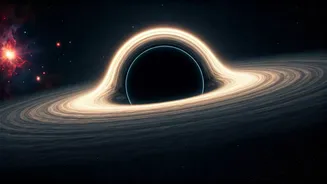
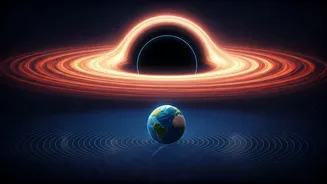
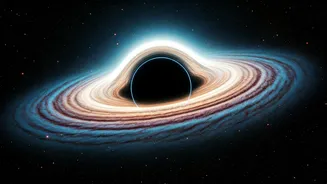
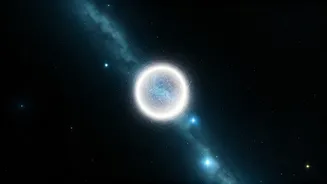
The remarkable observation centers on a star orbiting a supermassive black hole. The black hole, with its immense gravitational pull, caused the star to
exhibit a wobbling motion. This wobble, or frame-dragging, is precisely what Einstein predicted in his theory of general relativity. The effect occurs when a massive object, like a black hole, distorts the fabric of space-time, causing nearby objects to move in a swirling pattern. This effect, a subtle but significant deviation from a simple elliptical orbit, provided the evidence needed to confirm Einstein’s theories. This discovery has significant implications for how we understand the universe.
Einstein's Century-Old Prediction
Einstein proposed the concept of frame-dragging over a hundred years ago, describing how the rotation of a massive object could twist the space-time around it. This distortion, according to the theory, would cause the orbits of objects in the vicinity to change, following a spiraling path. These recent observations provided the concrete evidence to support this complex theoretical prediction. The alignment between the observed stellar motion and the frame-dragging effect was exceptionally close, confirming the validity of Einstein's principles with unprecedented precision. This confirmation acts as a testament to the enduring accuracy of Einstein’s predictions.
Telescopes Uncover Secrets
The observations required exceptionally sensitive instruments to detect the minuscule changes in the star's orbit. Advanced telescopes and sophisticated data analysis techniques were crucial to pinpoint the star's motion with the necessary accuracy. These tools are capable of measuring the positions of celestial objects with extreme precision, allowing astronomers to observe the subtle effects of frame-dragging. The success underscores the critical role of technology in advancing our comprehension of the universe. The use of innovative technologies has opened up new avenues for exploring the cosmos.
Impact on Cosmology
This validation of Einstein’s theory has wide-ranging implications for cosmology, the study of the origin, evolution, and structure of the universe. It strengthens the foundations of our understanding of gravity, which plays a central role in cosmic processes. The confirmation of frame-dragging offers valuable insights into the behavior of black holes, the formation of galaxies, and the large-scale structure of the cosmos. By refining our understanding of gravity, these observations pave the way for more accurate models of the universe and provide greater clarity in complex celestial phenomena. This research opens doors for further exploration.
Future Research Pathways
The confirmed observation opens up new avenues for research in astrophysics and cosmology. Scientists now have a clearer understanding of how gravity behaves and will delve deeper into exploring its effects on different celestial objects. They can test general relativity under extreme gravitational conditions, such as near black holes. These findings inspire future explorations, enabling researchers to probe the universe and understand its mysteries. Future studies may look to observe additional stars orbiting black holes, providing more data that could potentially refine the precision with which we understand the universe.