






Rock Formation Fundamentals
Our planet's crust, a mosaic of shifting tectonic plates, is the birthplace of all rocks. These colossal landmasses glide over the Earth's molten mantle,
a slow-motion ballet that shapes our world. When these plates converge, subduct, or diverge, they trigger a cycle of rock creation. The intense heat and pressure generated deep within the Earth can melt rock into magma, which then cools to form igneous rocks. Alternatively, existing rocks can be subjected to immense heat and pressure, undergoing a metamorphosis into entirely new structures. Furthermore, the forces of erosion, driven by wind and water, break down rocks into smaller fragments called sediment. Over eons, these sediments are compressed and cemented together, ultimately hardening into sedimentary rocks. These three fundamental processes—cooling of magma, transformation by heat and pressure, and consolidation of sediment—are responsible for the vast diversity of rocks found across the globe, each telling a unique story of Earth's geological past.
Igneous Rocks: Fiery Origins
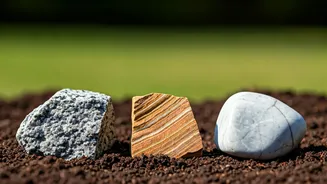
Igneous rocks are born from fire, originating from the molten heart of our planet. When magma, a superheated liquid rock, erupts onto the Earth's surface as lava or cools beneath the crust, it solidifies into igneous rock. This cooling process dictates the rock's texture. Rapid cooling, common for extrusive igneous rocks like basalt, results in fine-grained or even glassy textures due to limited crystal growth. Conversely, intrusive igneous rocks, formed from magma that cools slowly deep underground, like granite, develop large, visible crystals. The composition of the original magma, rich in elements like silica, iron, and magnesium, determines the specific minerals present in the resulting igneous rock. Vast geological features, such as the Columbia Plateau in the Pacific Northwest, are primarily composed of igneous rocks, showcasing the immense power of volcanic activity that shaped these landscapes over millennia. Exploring these areas offers a direct glimpse into the Earth's fiery creation processes.
Metamorphic Rocks: Transformed by Pressure
Metamorphic rocks are the result of profound transformation, forged under intense heat and pressure deep within the Earth's crust. These conditions do not melt the rock entirely but instead cause its existing minerals to recrystallize or rearrange, creating new textures and mineral compositions. For instance, shale, a sedimentary rock, can be transformed into slate under moderate pressure, and further heat and pressure can turn slate into schist or even gneiss, each exhibiting distinct layering and mineral banding. This process is a testament to the dynamic forces at play beneath the surface, driven by tectonic activity. While less common on the Earth's immediate surface compared to sedimentary rocks, igneous and metamorphic rocks constitute the vast majority—between 90 and 95 percent—of the top 10 miles of the planet's crust, underscoring their fundamental role in Earth's structure.
Sedimentary Rocks: Layers of History
Sedimentary rocks are Earth's storytellers, formed from the accumulation and cementation of rock fragments, minerals, and organic matter. This process begins with weathering and erosion, where existing rocks are broken down into smaller pieces called sediment by wind, water, ice, and biological activity. These sediments are then transported and deposited in layers, often in bodies of water like oceans, lakes, and rivers. Over vast stretches of time, the weight of overlying sediment compacts the lower layers, and dissolved minerals in groundwater act as a natural glue, cementing the particles together to form solid rock. Common examples include sandstone, formed from sand grains, and shale, from compacted mud. Sedimentary rocks are vital for understanding Earth's past environments, often containing fossils that provide evidence of ancient life. They are the most prevalent rock type on the Earth's exposed land surface, covering approximately 75 percent, making them the most likely type encountered by the everyday explorer.