





Sound's Bounce Back
Sound, much like light, behaves according to reflection principles when it encounters a barrier. In a room devoid of soft, porous materials like carpets
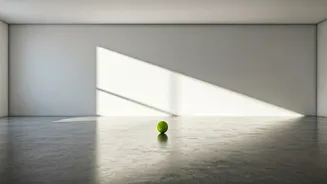
or upholstered furniture, there's little to absorb the energy of sound waves. Consequently, most of this energy is reflected off hard surfaces such as concrete, glass, or tile at virtually every angle. These surfaces function as highly efficient 'acoustic mirrors,' capable of bouncing back an astonishing 95-99% of the sound energy that hits them. This continuous reflection of sound energy off these hard boundaries is the primary reason why empty rooms sound so different from furnished ones.
Measuring Emptiness
To quantify how 'empty' a room is from an acoustic perspective, we analyze the sound energy it reflects versus absorbs. Every material possesses a unique absorption coefficient, indicating how much sound energy it can soak up upon contact. Hard, non-porous materials, like an unpainted brick or concrete wall, are particularly poor absorbers, reflecting upwards of 95% of incident sound. This means sound waves repeatedly strike these surfaces and reverberate, continuing their journey until their energy naturally dissipates. To manage and shape the sound within a space, particularly for audio production, specific acoustic treatments are necessary, which can range from specialized panels to the simple inclusion of furniture that naturally absorbs sound.
The Absent Absorbers
Sound travels more readily and for longer distances through an unoccupied room compared to a furnished one. The critical factor here is the absence of sound-absorbing elements. Upholstered furniture, thick carpets, and drapes all act as 'attenuators,' softening sound by absorbing its energy. In an empty room, these sound dampeners are missing, allowing sound waves to persist. Furthermore, in a highly reflective enclosed space, the sound level can actually intensify due to 'constructive interference.' This phenomenon occurs when reflected sound waves align with the original sound waves, amplifying the overall sound. The result is a much louder experience with a pronounced echo, unlike in a furnished room where the sound is naturally subdued.
Reflection Paths
The lack of furniture in a room creates unimpeded, long pathways for sound waves to bounce between parallel walls. This continuous reflection can lead to a distinct 'ringing' or 'booming' quality in the room's acoustics. When furniture is introduced, it disrupts these flat, extended reflective paths, diminishing or eliminating this effect. Since sound travels considerably slower than light, our ears can readily detect the time lag between the original sound and its reflection from a distant surface, perceiving it as a distinct echo. In smaller empty rooms, these reflections overlap so rapidly (in less than 0.1 seconds) that they are technically classified as reverberation rather than a distinct echo, though the general principle of prolonged sound decay remains.