







Dark Matter's Secrets
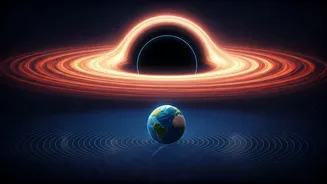
Dark matter, making up a significant portion of the cosmos, has long eluded direct detection. Invisible and interacting only through gravity, its presence
is inferred by its gravitational effects on visible matter, like galaxies. Despite extensive efforts, the exact composition of dark matter remains a mystery. The latest research indicates that these interactions might provide clues to understanding its behavior and properties, changing the existing scientific theories. These new insights open up avenues to study its nature.
Cosmic Ghost Particles
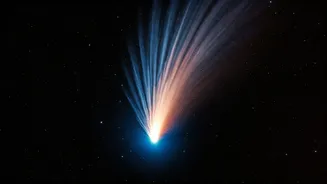
Scientists theorize that dark matter might interact with particles like neutrinos, also known as cosmic ghost particles, which are nearly massless and barely interact with other matter. Neutrinos are constantly produced in nuclear reactions, like the sun. These particles, because of their elusive nature, are difficult to detect, making their interactions with dark matter extremely interesting. If these interactions are proven, the current understanding of the properties of both dark matter and neutrinos could be significantly altered.
The Universe's Imbalance
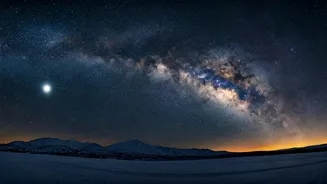
The research suggests the possibility of the universe being lopsided, meaning its structure might not be uniform across all directions. Cosmological models assume homogeneity and isotropy, that is, uniformity in all directions. If dark matter and neutrinos interact, it could create asymmetry, potentially explaining observed cosmic phenomena, such as large-scale structures and the distribution of galaxies. Any asymmetry could raise fundamental questions about the formation and evolution of the universe, suggesting that initial conditions or subsequent processes might not have been uniform.
Future Research Directions
These findings are opening the door for future research. Scientists are planning advanced particle detectors to probe dark matter and neutrino interactions. Observational astronomy will play a crucial role, analyzing data on cosmic microwave background radiation and the distribution of galaxies. Numerical simulations will allow researchers to model the interactions, and understand their impact on the universe. Confirming these interactions could validate new theories and potentially provide a unified understanding of dark matter, neutrinos, and the overall structure of the cosmos.