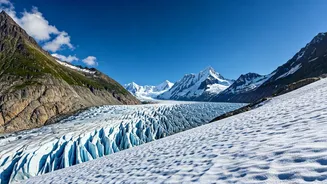







Summer Acceleration Observed
The research, a groundbreaking study, used data to construct a global map that visualizes the seasonal speed variations of glaciers. It discovered that glaciers exhibit
a clear pattern: they tend to move faster during the summer months. This acceleration is often linked to increased meltwater from the ice sheets, which lubricates the glacier's base, allowing it to slide more quickly. The summer speeds contribute significantly to the overall ice loss that has been observed globally. This enhanced understanding of glacial dynamics provides scientists with essential insights into the influence of seasonal temperature changes on glacier behavior.
Winter Slowdown Explained
As winter sets in, glaciers experience a slowdown in their movement. This deceleration is primarily due to the freezing of meltwater, which reduces lubrication at the glacier's base. The colder temperatures also cause the ice to become more rigid, further decreasing its flow. Scientists observed that this seasonal fluctuation is a natural process, but its intensity and the duration of these periods are essential indicators of broader climate changes. These winter slow downs are a natural response to the environment, but observing how much and for how long helps scientists monitor the effects of global warming.
Global Map Significance
The creation of a global map representing glacier speed variations marks a crucial step in climate science. This map provides a detailed view of how glaciers respond to seasonal changes across the globe. Researchers can utilize this tool to monitor the impact of climate change on a large scale. They can see regional differences in glacial behavior, contributing to a better understanding of the overall trends. The mapping effort underscores the importance of ongoing monitoring and the integration of diverse data sources to deepen the understanding of Earth's complex systems. The map is a valuable resource for climate modelers, helping them refine predictions and projections.
Impacts of Climate Change
The research highlights the sensitivity of glaciers to changing temperatures. Glaciers act as critical indicators of climate change because the rate at which they move is strongly influenced by temperature fluctuations. The increase in average temperatures across the globe accelerates glacial melting and, in turn, influences the rate of glacial movement. These changes have significant consequences, including rising sea levels, changes in regional water supplies, and ecosystem alterations. The study emphasizes the urgent need for reducing greenhouse gas emissions to mitigate the adverse impacts of climate change.
Future Research Directions
The ongoing efforts in glacier research are focused on refining models and expanding data collection. Scientists are keen on integrating new data streams, like data from satellites and advanced sensors, to improve the accuracy of their assessments. This will lead to a more in-depth knowledge of how glaciers interact with the Earth's systems. Future studies are also likely to explore the influence of other factors, such as precipitation patterns, on glacial behavior. The goal is to build comprehensive models that are capable of predicting glacier dynamics under various climate scenarios, offering crucial insights for policy and management.