






Solar Cacophony Explained
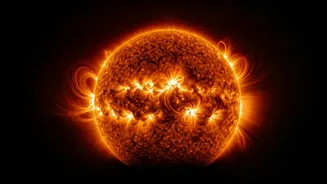
The Sun, our closest star, is a powerhouse of acoustic energy, a result of the constant turbulence and boiling gases on its surface and within its core.
These energetic processes generate pressure waves that, on a planet with an atmosphere like Earth, would be perceived as sound. Scientists estimate that if we could somehow measure the Sun's sound intensity at its surface, it would reach a staggering 100 decibels. This level of sonic output is so colossal that, when hypothetically translated to Earth's atmospheric conditions, it's likened to the deafening roar produced by over 100 trillion jet engines operating simultaneously. The sheer density of solar matter and the immense energy involved contribute to this unfathomable loudness, creating vibrations that are a fundamental aspect of solar activity, alongside its well-known emissions of light and heat.
The Silence of Space
Despite the Sun's internal sonic tempest, the vast expanse of space remains profoundly silent. This silence is not due to a lack of energetic phenomena but rather the fundamental nature of sound itself. Sound waves require a medium – such as air, water, or solids – to propagate from their source to a receiver. Space, for the most part, is a near-perfect vacuum, devoid of the necessary particles for sound waves to travel. Therefore, while the Sun's energetic core and turbulent surface generate immense acoustic energy, this energy is largely contained within the Sun's own plasma. It cannot traverse the vacuum to reach our ears or even our planet, making the Sun's theoretical roar an experience confined solely to the star itself.
Listening to the Sun
While we cannot hear the Sun directly, scientists have developed ingenious methods to study its internal workings through its vibrations. The field of helioseismology employs a technique that uses these sound waves as probes to understand the Sun's interior structure. By analyzing the subtle tremors and oscillations that ripple through the Sun, researchers can map its inner layers, much like medical ultrasounds are used to image the human body. These captured vibrations, though deep and resonant, can be recorded and even played back through specialized equipment, offering a unique, albeit indirect, auditory experience of our star. This scientific approach allows us to glean crucial information about the Sun's behavior, its life cycle, and the complex processes occurring deep within its fiery heart.