





Journey to Launch
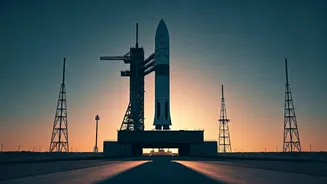
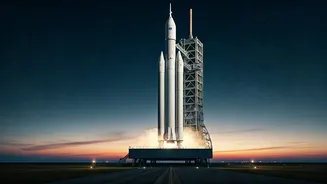
The colossal Space Launch System (SLS) rocket, integrated with the Orion spacecraft, has completed its intricate journey from the Vehicle Assembly Building
(VAB) to Launch Complex 39B at NASA's Kennedy Space Center. This carefully orchestrated move, spanning approximately 4 miles (about 6.4 kilometers), commenced in the early hours of the morning, departing the VAB at 12:20 am Eastern Time and arriving at its launch destination by 11:21 am. This lengthy, 11-hour operation signifies a critical milestone, bringing the hardware for the Artemis II lunar mission one step closer to its historic departure. The successful transport is a testament to the meticulous planning and execution by NASA's dedicated teams, paving the way for the final pre-launch checks.
Pre-Launch Preparations Underway
With the SLS rocket and Orion spacecraft now firmly positioned on the launch pad, NASA teams are diligently engaged in the final stages of preflight activities. The target launch window for the Artemis II mission is set to open on April 1 and will extend through April 6. These preparations follow a recent return to the VAB, necessitated by an issue discovered during a wet dress rehearsal on February 21. The problem prevented helium from flowing correctly to the rocket's upper stage. While in the VAB, engineers seized the opportunity to conduct essential maintenance and system upgrades. This included refreshing and retesting multiple crucial systems, activating new flight termination system batteries, replacing batteries on various components like the upper stage, core stage, and solid rocket boosters, and ensuring Orion's launch abort system batteries were fully charged.
Critical System Refinements
Further detailed work was performed on the SLS rocket and Orion spacecraft during their recent stay in the Vehicle Assembly Building. Engineers undertook the vital task of replacing a seal on the core stage's liquid oxygen feed line, a component essential for the rocket's ascent. Following this replacement, the oxygen tail service mast umbilical plate was meticulously reassembled and subjected to rigorous retesting to confirm a completely secure and leak-proof seal. These intricate procedures are paramount for ensuring the safety and success of the Artemis II mission. Concurrently, other systems, including those on the Orion spacecraft, underwent necessary battery servicing and testing, demonstrating NASA's commitment to thoroughness and redundancy in preparing for deep space exploration.
Artemis II Mission Overview
The upcoming Artemis II mission represents a significant step in NASA's ambitious lunar program, aiming to send a crew of four astronauts on an approximately 10-day journey that will take them around the Moon and safely back to Earth. This mission serves as a crucial precursor to more complex lunar endeavors. The crew members for this historic flight have been named: NASA astronauts Reid Wiseman, Victor Glover, and Christina Koch, alongside Canadian Space Agency astronaut Jeremy Hansen. Their voyage will provide invaluable data and operational experience for future missions, including the planned Artemis III, which intends to feature a rendezvous and docking with commercial lunar landers developed by companies like SpaceX and Blue Origin.