


Comets: Cosmic Deliverers
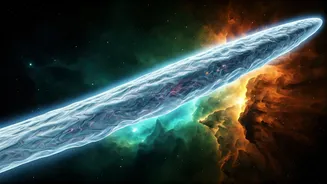
Recent scientific investigations are illuminating the profound impact of comets on Earth's capacity to harbor life. These icy celestial bodies, originating
from the frigid outer reaches of our solar system, are now understood to have been far more than just passive observers of our planet's evolution. Emerging research suggests that comets acted as crucial delivery systems, transporting vital chemical compounds and water to early Earth during its formative stages. This constant bombardment by comets could have provided the necessary ingredients—organic molecules, amino acids, and water—that are fundamental to life as we know it. The sheer volume of material delivered over billions of years may have significantly altered Earth's atmospheric composition and surface conditions, creating a more hospitable environment for the first stirrings of biological activity. Thus, the story of life on Earth might be inextricably linked to the journeys of these ancient, icy visitors from the cosmos.
Irradiation and Life's Origins
The journey of a comet through space exposes its icy composition to intense radiation, a process that scientists believe is key to understanding their role in life's genesis. As comets traverse the solar system, they are bombarded by cosmic rays and solar radiation. This energetic bombardment can trigger complex chemical reactions within the ice, transforming simple molecules into more complex organic compounds. These complex molecules, including amino acids and nucleobases—the fundamental building blocks of proteins and DNA—are precisely what early Earth might have needed to initiate biological processes. Instead of life arising solely from terrestrial sources, it's increasingly plausible that a significant portion of these essential organic materials were delivered from extraterrestrial sources via cometary impacts. The 'irradiated' nature of comets, therefore, transforms them from mere frozen relics into potential cosmic incubators, forging the very molecules that underpin all known life forms on our planet and potentially elsewhere.
The 'Bouncing' Comet Hypothesis
The concept of 'bouncing' comets introduces a fascinating dynamic to how life's seeds might have been dispersed across the galaxy, including to our own planet. This idea posits that comets, upon their close encounters with planetary systems, don't just impact and disintegrate; they may also interact gravitationally in ways that allow them to 'bounce' or be ejected with significant portions of their material intact. This 'bouncing' mechanism could effectively act as a form of interstellar transport for prebiotic molecules. Imagine a comet passing near a nascent planet rich in life's precursors; it could pick up these materials and then, through a gravitational slingshot maneuver, be propelled towards another star system. This suggests that the 'seeds' of life aren't confined to a single planetary origin but can be widely distributed by these nomadic icy bodies. The implications are vast, suggesting that life's potential is not a rare terrestrial accident but possibly a cosmic phenomenon facilitated by the movement of comets throughout the universe, making the possibility of life elsewhere more probable.