






Wasp's Rapid Spread
Scientists have observed a fascinating phenomenon: an all-female wasp species is rapidly expanding its territory across the elm trees of North America.
This rapid proliferation is a testament to the effectiveness of their reproductive strategy, highlighting their ability to thrive in a new environment. Further study is required to understand the full impact this has on the local ecosystem and the elms themselves. The speed at which these wasps have colonized new areas is noteworthy, underscoring their remarkable adaptability and potential consequences for the existing insect populations and the health of the elm trees. The absence of males means the wasp uses parthenogenesis, where eggs develop without fertilization. This allows for exponential population growth and colonization of new areas at an unprecedented pace. The adaptability and success of this all-female species pose interesting questions about the stability and dynamics of ecosystems and how organisms adapt to survive.
Dandelion's Upward Trick
The seemingly simple dandelion has a surprising trick up its sleeve to ensure its seeds travel far and wide. The plant uses the upward movement of warm air currents, exploiting the physics of the environment. Each delicate seed head acts as a miniature parachute, designed to catch these rising currents and carry the seeds away. Research into this mechanism provides a fascinating study in plant adaptation and environmental interplay. Dandelions can be found everywhere, which shows just how effective their seed dispersal strategy is. This process is more efficient than it may appear at first glance. It ensures that the seeds are dispersed over a vast area, increasing the chances of survival for the species. The shape of the seed head and its specific design maximize the seeds' chances of being transported away by the wind.
Ant-Scented Flower
A peculiar flower has been discovered that uses a clever strategy to attract pollinators. This particular plant emits a scent that mimics injured ants, effectively drawing in flies, which become unwitting participants in the pollination process. This is an example of the complex evolutionary strategies employed by plants to reproduce and survive. The scent, which mimics the distress signals of ants, manages to lure the flies, leading them to the flowers, thereby facilitating pollination. This adaptation shows the incredible diversity of survival tactics found in nature. The flowers exploit the flies' interest in a source of food, as well as the scent released by injured ants, to attract them and achieve the goal of reproduction. It represents the intricate web of interactions found in an ecosystem.
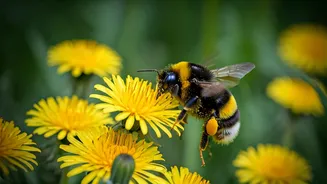
Ancient Bumblebees Unearthed
Recent findings have uncovered ancient bumblebees, which offer a valuable glimpse into the past. These specimens were discovered with their pollen sources still intact, giving scientists a direct insight into the diets and environments of bees from long ago. This discovery allows for a greater understanding of the development of bumblebees and their environments. The fact that the pollen source was preserved with the bees means it is possible to reconstruct the food chains and ecological niches of these prehistoric insects. Such data is invaluable in understanding how species have changed over millennia and how they have adapted to shifting climate and environmental circumstances. It gives a detailed picture of the relationship between these ancient bumblebees and their food sources.