






A Stellar Discovery
The universe continues to surprise and amaze us with its hidden wonders. Recently, astronomers made an interesting observation that pointed to a possible
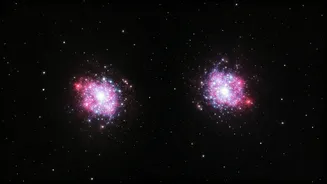
stellar relationship. This new star cluster has been spotted in the vicinity of Czernik 38, a well-documented open cluster, a grouping of stars that formed together from the same giant molecular cloud. This finding is particularly interesting because it suggests the potential existence of a binary open cluster, a scenario where two star clusters are gravitationally bound, moving together through space. Such pairings are relatively uncommon compared to solitary clusters, making this discovery a significant contribution to astronomical knowledge.
Close Proximity Explained
What makes the recent discovery all the more compelling is the close spatial relationship between the newly found cluster and Czernik 38. The fact that these two clusters exist relatively close to each other in the vastness of space suggests a common origin or shared history. The spatial proximity, while not definitive proof, strongly hints that they might be gravitationally linked. Scientists believe that this link is critical for understanding the mechanics of how stars are created and grow. Further investigation of the cluster's characteristics, like star age, composition, and their patterns of movement, will play a vital role in understanding the nature of this relationship and confirming whether they are indeed binary companions.
Binary Star Clusters?
The potential discovery of a binary open cluster opens up fascinating possibilities for how we view star cluster formation. If confirmed, this would imply that the two clusters were likely born from the same molecular cloud, eventually separating over time due to gravitational interactions. This theory presents a deeper dive into the processes behind star birth and cluster evolution. Studying the dynamics, star composition, and spatial distribution within both clusters will be key to understanding whether this is a true binary system. These observations are incredibly crucial, providing invaluable data points that can be used to refine and test existing theories of star formation and cluster evolution. This research could illuminate how stars are formed within clusters, and how the clusters interact with each other.
Future Research Awaits
This intriguing discovery warrants further in-depth investigation by astronomers. They plan to collect more data about the newly discovered cluster, including its age, the chemical compositions of its stars, and its velocity. Detailed observations will help to accurately assess the relationship between this cluster and Czernik 38. The aim is to establish if these clusters are moving in concert, sharing a common origin. Detailed spectroscopic analyses will allow astronomers to determine the types of stars, and their distances, that make up each cluster. These pieces of information will provide a detailed picture and allow them to test various models about their formation and evolution. The information will not only help them better understand our universe, but also give us a greater understanding of the complex relationships that exist among celestial objects.