
Bennu's Cosmic Embrace
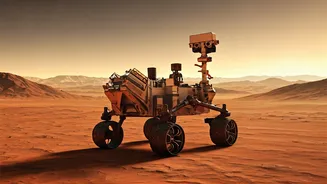
OSIRIS-REx embarked on a remarkable journey, reaching out to asteroid Bennu to collect samples. The spacecraft delicately touched down on the asteroid,
gathering dust and rocks, with the goal of bringing these ancient materials back to Earth. This mission showcased advanced engineering and deep space exploration. The spacecraft successfully collected its precious cargo, a key moment in the mission's history. The samples, believed to contain clues about the solar system's formation, were carefully stowed away. The success of this endeavor marked a significant achievement for international collaboration in space exploration, opening new avenues for scientific discoveries and technological advancements. This mission represented an extraordinary voyage into the depths of space to unlock the secrets of our cosmic origins and the formation of planets. The data collected could potentially change our understanding of how life began.
Sample's Homebound Voyage
The journey back to Earth with the asteroid samples is a critical phase of the OSIRIS-REx mission. The spacecraft is now safely en route, meticulously navigating through space. The samples are shielded within a specialized container to protect them from the harsh environment of space. Throughout the journey, the team on Earth will make crucial corrections to the spacecraft's course, with regular checks to ensure everything is functioning correctly. The mission engineers are prepared to deal with any situation that might arise during the journey home. This phase is characterized by precision and patience, and the entire team awaits the samples' return with great anticipation. The data that is expected to be extracted from the samples is what is making this mission so important.
Future Mission Preview
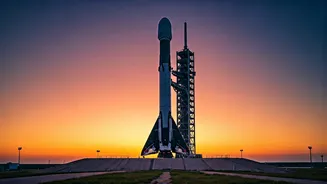
While OSIRIS-REx is on its way back, preparations for the future are already underway at NASA. Plans for upcoming spacewalks on the International Space Station, focused on solar array upgrades, have been announced for January 2026. The agency has also shared what can be expected from the mission. It is looking to increase our knowledge of the universe. This will enable us to push the limits of technology, inspire the next generation of space explorers, and expand our knowledge of how life began. The next mission is to give scientists access to asteroid samples. NASA is taking significant steps in expanding our understanding of the cosmos by continuing to advance space exploration.
Bennu's Protective Armour
A fascinating study reveals that the rocks found on the surface of asteroid Bennu act as 'body armour' against small meteoroids. This insight comes from the analysis of the asteroid's surface, which shows the effects of space weathering and impacts from micrometeoroids. Boulders are essential for shielding the asteroid. This knowledge improves scientists' understanding of asteroids and provides further insight into the processes that shape them. This discovery has significant implications for future missions. The surface protection offered by the asteroid's rocks contributes to its resilience in the harsh environment of space. Studying these protective characteristics helps the scientists choose areas that are more likely to provide high-quality samples.
OSIRIS-REx's Legacy
The OSIRIS-REx mission is an important endeavor. Its mission has demonstrated advancements in robotic space exploration. Its achievements in sample collection from an asteroid have paved the way for future sample-return missions. The gathered samples are expected to provide insights into the early solar system's origins, potentially uncovering the building blocks of planets and organic molecules that might have led to life. The mission has boosted international collaboration in space research. Scientists are getting ready to analyze samples, and this is expected to lead to breakthroughs in our understanding of the universe. The mission's success has inspired space agencies around the world, opening doors for even more advanced exploration missions.