




When to Watch
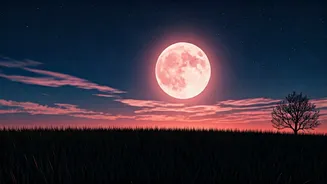
The highly anticipated 'Pink Moon,' marking the first full moon of spring, is set to reach its zenith of illumination on April 2nd. While its peak occurs
in the early hours of Thursday, April 2nd, the most breathtaking visual experience is anticipated on the evening of Wednesday, April 1st. As the moon begins its ascent above the horizon, it offers the most dramatic and visually appealing display for skygazers. This lunar event is a prime opportunity for observation, providing a stunning celestial performance for all who look up.
The Deceptive Name
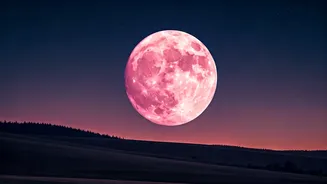
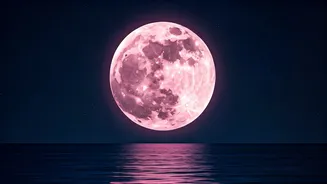
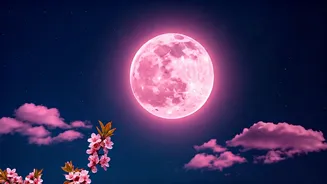
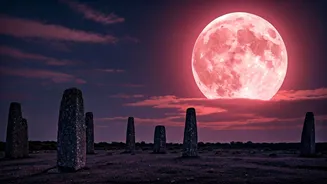
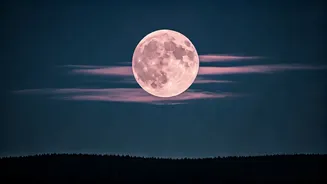
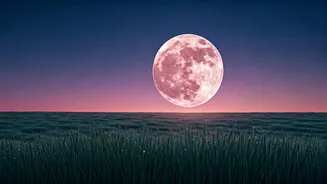
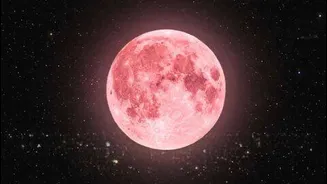
Contrary to its vibrant moniker, April's 'Pink Moon' will not actually appear as a pink orb in the night sky. The name's origin is deeply rooted in history and tradition, stemming from early Native American tribes who used lunar cycles to track the changing seasons. They associated this particular full moon with the abundant blooming of pink wildflowers, most notably the wild ground phlox, which carpeted the landscape in early spring. Thus, the name is a tribute to the season's floral heralds rather than the moon's actual color, which will likely present in warmer tones.
Science of the Glow
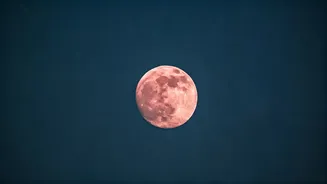
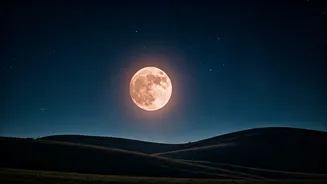
The visually appealing orange or golden hue of the 'Pink Moon' when it appears low on the horizon is a fascinating result of atmospheric optics. As the moon rises or sets, the light reflecting off its surface must traverse a considerably longer path through Earth's atmosphere to reach our eyes. Our atmosphere is laden with particles that scatter light. Shorter wavelengths, such as blues and violets, are dispersed in various directions, while longer wavelengths, like reds, oranges, and yellows, are less affected and can penetrate the atmosphere more effectively. This phenomenon, where longer wavelengths dominate, lends the moon its characteristic warm, coppery, or golden appearance, much like the beautiful colors seen during a sunset.
Companion in Virgo
Adding an extra layer of wonder to this lunar event, the 'Pink Moon' will be accompanied by a brilliant celestial neighbor. As you admire the moon, direct your gaze towards a remarkably bright point of light situated nearby. This is not an ordinary star; it is Spica, a luminous binary star system nestled within the Virgo constellation. The close proximity of Spica to the full moon creates a visually striking and dynamic tableau in the night sky, offering an excellent opportunity for amateur astronomers and casual observers alike to appreciate the intricate beauty of our cosmos.
Holiday Significance
Beyond its astronomical appeal, the 'Pink Moon' carries substantial cultural and religious importance, serving as a key marker for the timing of major global holidays. Specifically, it dictates the dates for both Easter and Passover celebrations. The ancient rule for Easter states it will always fall on the first Sunday subsequent to the first full moon occurring after the spring equinox. Given that this year's astronomical spring equinox arrived on March 20th, this April full moon is the determining celestial event that solidifies the dates for the upcoming holiday observances for millions worldwide.
Weather Watch
The visibility of any astronomical phenomenon is, of course, heavily dependent on prevailing weather conditions. For observers in the UK, the forecast for viewing the 'Pink Moon' appears to be a mixed proposition. Current meteorological predictions suggest that skywatchers in England and Wales might encounter challenges due to expected heavy cloud cover and intermittent rain on Wednesday night, potentially obscuring the view. However, the outlook is more promising further north. Scotland and Northern Ireland are anticipated to experience colder air masses, which typically translates to a higher likelihood of clear skies and uninterrupted opportunities to witness the lunar display.