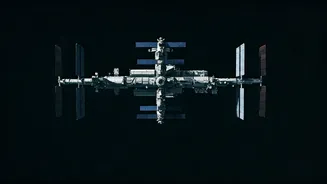








A Historic Moment
The ISS made history with eight spacecraft docked simultaneously, representing an unprecedented level of activity in orbit. This extraordinary event highlights
the progress made in space exploration and the collaborative nature of international space programs. Eight separate vehicles were linked to the ISS at the same time, signifying the culmination of years of technological development and international cooperation. This unprecedented docking feat demonstrates the ISS's capacity to host diverse missions and experiments and highlights the station's pivotal role in facilitating space-related activities.
International Collaboration
The successful docking of multiple spacecraft underscores the importance of international partnerships in space exploration. Various space agencies from different countries worked together to make this event a reality. The collaborative efforts involved meticulous planning, advanced engineering, and effective communication among international teams. This cooperation fostered knowledge exchange, resource sharing, and risk mitigation, ultimately contributing to the success of the mission. The ability of multiple nations to collaborate in such a complex endeavor emphasizes the potential of global cooperation in advancing scientific research and technology.
Advancements in Tech
This achievement is a testament to the advancements in spacecraft design, docking mechanisms, and space station infrastructure. The precision required for multiple spacecraft to dock safely and efficiently at the ISS is a result of years of technological development. The docking systems, navigation instruments, and communication technologies have evolved to support complex space operations. Furthermore, the design of the ISS, with its multiple docking ports, contributed significantly to this record. The ability to manage and maintain the station while accommodating multiple visiting vehicles showcases the continuous progress in space exploration technology.
Future Implications
The record-setting event foreshadows the future of space exploration, particularly the expansion of commercial space activities. The ability to accommodate multiple spacecraft indicates the ISS's potential to support a wide array of missions, from scientific research to commercial ventures. The station can serve as a hub for astronauts, conduct experiments, and facilitate space-based manufacturing. As private companies develop their own space stations, the lessons learned from the ISS and its ability to host multiple vehicles at once will be invaluable. The achievement suggests that future space exploration will involve increasing levels of collaboration and utilization of space infrastructure.