



A Stroke of Luck
In a truly serendipitous turn of events, the Hubble Space Telescope, renowned for its keen astronomical observations, managed to capture an extraordinary
phenomenon: a comet fracturing in real-time. The chances of such an event being observed at the precise moment of disintegration are astronomically slim, making this discovery particularly valuable. Published in the esteemed journal _Icarus_, this observation is yielding unprecedented insights into the composition of ancient icy remnants from the solar system's formation. The comet in question, identified as C/2025 K1 (ATLAS), was not the primary subject of the observation campaign. Co-investigator John Noonan from Auburn University highlighted the unexpected nature of the discovery, stating that the best scientific findings often arise from fortunate accidents. Their original target comet became unobservable due to unforeseen technical issues, prompting the selection of a new target. Astonishingly, as soon as observations began, this new target comet began to break apart – a scenario with incredibly low probability.
Hubble's Fragmented View
A series of images captured by the Hubble Space Telescope over three consecutive days – November 8, 9, and 10, 2025 – vividly illustrate the progressive disintegration of comet C/2025 K1 (ATLAS), or K1 for short. Utilizing the Space Telescope Imaging Spectrograph (STIS) instrument, Hubble documented K1 splitting into at least four discernible pieces. Each fragment was observed to possess its own distinct coma, the fuzzy envelope of gas and dust surrounding a comet's icy nucleus. While Hubble's advanced optics clearly resolved these individual fragments, ground-based telescopes could only resolve them as faint, indistinct smudges. This remarkable observation marks the first time Hubble has witnessed a comet undergoing fragmentation so early in the process, offering a detailed look at the initial stages of such a dramatic cosmic event. The images themselves are a testament to Hubble's enduring capabilities in capturing fleeting and vital astronomical phenomena.
Unraveling Comet Secrets
The discovery of the comet's fragmentation was made by John Noonan when he reviewed the Hubble data the following day. His surprise at seeing four comets in the images when only one was intended for study underscores the significance of the accidental observation. Researchers had long sought to observe cometary fragmentation with Hubble, submitting numerous proposals over the years, but the challenge of timing such an event had always thwarted their efforts. Principal investigator Dennis Bodewits, also from Auburn University, remarked on the poetic irony of a 'regular' comet crumbling before their eyes. Comets, being ancient leftovers from the solar system's formation, are composed of primordial materials. However, they are not pristine, having been altered by solar radiation and cosmic rays over eons. This makes it challenging for scientists to distinguish between inherent primitive properties and those resulting from evolutionary processes. By studying fragmented comets, scientists can access and analyze this ancient material before it has been further processed or altered, offering a more direct window into the early solar system.
Anatomy of a Breakup
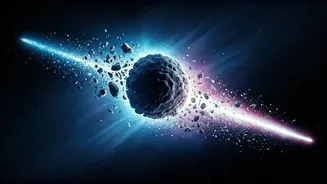
Hubble's detailed imagery confirmed that comet K1 had fractured into a minimum of four separate components, each displaying its own surrounding coma, the characteristic gaseous halo. The clarity of Hubble's observations allowed scientists to clearly distinguish these fragments, a feat that proved difficult for ground-based instruments, which could only detect them as faint luminous masses. This breakup occurred approximately one month after K1 reached its perihelion, the point in its orbit closest to the Sun. During this phase, the comet ventured inside Mercury's orbit, experiencing intense solar heating and significant stresses. Such conditions are known triggers for the disintegration of long-period comets. Prior to fragmenting, K1 was estimated to be slightly larger than an average comet, with a diameter of about five miles. Scientists believe the fragmentation process commenced roughly eight days before Hubble's observation period. The telescope captured three 20-second exposures on consecutive days in November 2025, during which one of the smaller fragments itself underwent further subdivision.
The Brightness Puzzle
Hubble's exceptional resolution enabled researchers to precisely track the fragments backward in time, allowing them to determine when they were still part of a single nucleus. This reconstruction of the breakup timeline led to an intriguing mystery: why did the comet's brightness not increase immediately after splitting, as expected? When fresh ice is exposed upon fragmentation, it is anticipated to sublimate rapidly and increase the comet's luminosity. However, in this case, there was a delay. Scientists have proposed several explanations for this phenomenon. One theory suggests that a dry dust layer must first form over the newly exposed ice before it can be ejected by sublimation. Another hypothesis posits that heat slowly penetrates the comet's subsurface, building pressure until it triggers the expulsion of a dust cloud. This observation provides crucial data for understanding the timescales involved in dust layer formation and ejection mechanisms on cometary surfaces. It offers a unique opportunity to study the physics governing cometary behavior during and immediately after fragmentation.
Unusual Chemistry, Final Voyage
Ongoing investigations into the gases released by comet K1 are revealing unusual chemical properties. Initial ground-based observations indicate a significantly lower carbon content compared to most comets. Further detailed analysis using Hubble's STIS and Cosmic Origins Spectrograph (COS) instruments is expected to provide more comprehensive data on K1's composition. This information could offer valuable clues about the composition of the early solar system. Currently, the fragmented remains of K1 are drifting approximately 250 million miles from Earth, located within the constellation Pisces. The comet is on a trajectory away from the solar system, making its return unlikely. This journey represents the final phase of its existence as a celestial body observed by humanity. The Hubble Space Telescope, after more than three decades of operation, continues to be a pivotal instrument in expanding our understanding of the cosmos, contributing to discoveries that deepen our knowledge of the universe and its origins.