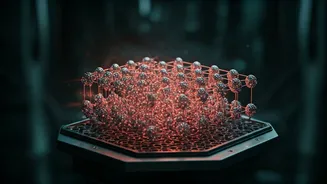

Quantum Computing's Promise
Quantum computing represents a paradigm shift in computational capabilities, exceeding the limitations of classical computers. This advancement hinges
on the unique principles of quantum mechanics, where qubits – the fundamental units of quantum information – exist in a superposition of states, allowing them to perform complex calculations far more efficiently than their classical counterparts. This technology holds immense potential to revolutionize fields like drug discovery, materials science, and artificial intelligence, offering solutions to problems currently intractable for even the most powerful supercomputers. The ability to simulate quantum systems accurately and efficiently opens new avenues for understanding matter at its most fundamental level, leading to the development of novel materials and innovative technologies. Moreover, the promise of secure communication and enhanced data analysis capabilities further fuels the drive towards developing scalable and robust quantum computers.
Qubit Types Explained
Quantum computers utilize qubits, the quantum analogue of classical bits. These qubits can be realized using various physical systems, each with unique advantages and disadvantages. One prominent approach involves superconducting qubits, where quantum information is encoded in the state of superconducting circuits. These qubits have shown remarkable progress in terms of coherence times and gate fidelities, crucial metrics for quantum computation. Trapped ions, another leading technology, employ individual ions confined and controlled by electromagnetic fields. These qubits excel in their high fidelity and long coherence times, but scaling up the number of qubits remains a challenge. Neutral atoms, a rapidly evolving technology, use neutral atoms trapped and controlled by light. These systems offer scalability and high connectivity, making them a promising candidate for building large-scale quantum computers. The choice of qubit type depends on the specific application and the trade-offs between different performance metrics, such as coherence time, gate fidelity, and scalability. Advances in qubit technology are key to realizing the full potential of quantum computation.
Neutral-Atom Advantages
Neutral-atom quantum computers stand out due to their potential for scalability and high connectivity. These systems trap and manipulate individual neutral atoms using focused laser beams, allowing for precise control and manipulation of quantum states. This approach has several advantages over other qubit technologies. Neutral atoms are naturally identical, simplifying the design and fabrication of quantum processors. The use of optical tweezers to trap and manipulate atoms enables a high degree of connectivity between qubits, facilitating the implementation of complex quantum algorithms. The relatively simple architecture of neutral-atom systems also offers potential for scalability, allowing for the creation of larger and more complex quantum processors. Moreover, the development of new techniques for manipulating and controlling neutral atoms continues to enhance the performance and capabilities of these quantum computers, making them a promising avenue for building large-scale quantum systems capable of tackling complex computational tasks.
Light-Matter Thermalization
Recent advancements have unveiled new insights into light-matter thermalization, and these breakthroughs have profound implications for neutral-atom quantum computing. Thermalization, in this context, refers to the process by which a quantum system equilibrates with its environment, losing information and coherence. Researchers have been investigating the interaction between light and matter to understand and mitigate this process. The ability to control and understand thermalization opens new possibilities for enhancing the performance of neutral-atom qubits. For example, by carefully controlling the interaction between light and atoms, scientists can reduce the loss of quantum information due to thermal effects. This improved understanding of thermalization mechanisms is crucial for developing robust and reliable quantum computers, as it allows researchers to minimize the impact of environmental noise and improve the overall performance of the quantum system. Further research in this area will continue to refine the capabilities of neutral-atom quantum computers, paving the way for larger and more complex quantum processors.
Simulation Findings & States
Computer simulations play a crucial role in understanding and optimizing the performance of quantum systems, particularly the dynamics of quantum processors. Researchers are using simulations to explore the behavior of neutral-atom qubits under various conditions, including different types of interactions and environmental noise. These simulations help in predicting and controlling the performance of the system, paving the way for enhancements. One key aspect of this research involves studying prethermal states, which are quantum states that exhibit behavior distinct from thermal equilibrium. Understanding and utilizing these prethermal states could be essential for developing novel quantum algorithms and improving the performance of quantum computers. The simulations allow scientists to model complex quantum phenomena, optimize experimental parameters, and predict the behavior of quantum systems. These findings contribute to the development of better control strategies for qubits and help in the design of more efficient and robust quantum processors, contributing to progress in quantum computing.
Challenges & Future
Despite the remarkable progress in quantum computing, significant challenges remain in the path toward building large-scale, fault-tolerant quantum computers. One key hurdle is the need for improved qubit control and coherence times. Maintaining the fragile quantum states of qubits is crucial for performing complex calculations, and environmental noise can easily disrupt these states. Another major challenge lies in developing effective error correction techniques to mitigate the impact of noise and errors. Quantum error correction is a complex area, and new algorithms and strategies are required for building reliable quantum computers. Further advancements are also required in the scalability of quantum systems. Building quantum computers with thousands or even millions of qubits requires innovations in hardware design, fabrication techniques, and control systems. The future of quantum computing is bright, and this field is rapidly evolving. Overcoming these challenges will require concerted effort across various disciplines, including physics, computer science, and engineering. The ongoing research in quantum algorithms, hardware design, and error correction techniques will push the boundaries of what is possible, bringing the promise of quantum computing closer to reality.