




New Mission, Old Doubts
NASA's Artemis II mission, slated for late 2024, represents a monumental leap towards re-establishing human presence beyond Earth's orbit, with astronauts
embarking on a trajectory around the Moon for the first time since the Apollo era. This endeavor is a cornerstone of the larger Artemis program, which envisions a sustainable lunar outpost serving as a springboard for future Martian explorations. However, the anticipation surrounding Artemis II has also unfortunately coincided with a resurgence of long-standing conspiracy theories that question the authenticity of the original Apollo moon landings. These persistent doubts, which have circulated for decades, often center on perceived anomalies in photographic and video evidence from past missions, such as the apparent lack of stars, the way the lunar flag seemed to ripple, and inconsistencies in shadow patterns, all interpreted by deniers as proof of a terrestrial fabrication designed to secure a Cold War victory.
Debunking Persistent Myths
The scientific community and NASA have consistently addressed and refuted these conspiracy theories with a wealth of evidence. This includes physical samples of lunar rocks brought back from the Moon, independent verification from international space agencies, and extensive documentation from the Apollo missions. Scientific explanations for the alleged anomalies are well-established, primarily attributing them to the unique lighting conditions on the Moon's surface, the limitations of early photographic equipment, and the specific effects of the vacuum and radiation environment. Despite this overwhelming scientific consensus, conspiracy theories continue to gain traction, amplified by the reach of social media platforms. The appeal of these theories can be multifaceted, sometimes rooted in a general distrust of governmental institutions, a fascination with hidden truths, or a preference for alternative narratives over established facts.
Context Matters for Clips
A recent viral clip featuring Artemis II commander Reid Wiseman has inadvertently fueled these old claims, with some interpreting his words out of context as an admission of a faked landing. The brief 25-second excerpt, taken from a longer recording in September 2025, features Wiseman stating, "This is the first time we’re going to send humans to the moon and, at the same time, have humans in low Earth orbit." Conspiracy theorists quickly seized upon this phrase, suggesting it was a confession. However, this fragment overlooks Wiseman's earlier, explicit acknowledgment of the Apollo missions within the same session. He clarified that he was referring to the dawn of a new era in lunar exploration and observation, rather than the initial human voyages. In fact, approximately 20 minutes prior to the clip in question, Wiseman had stated, "We have been to the moon in Apollo," underscoring the historical context of lunar travel and how Artemis II builds upon it.
Artemis II's Historic Goals
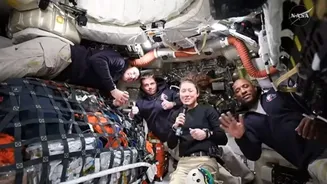
The Artemis II mission itself is designed to be a significant milestone, marking the first crewed journey toward the Moon since 1972 and the first time astronauts will venture beyond low Earth orbit in over five decades. The four-person crew, comprising NASA astronauts Reid Wiseman, Victor Glover, and Christina Koch, alongside Canadian astronaut Jeremy Hansen, will embark on a 10-day orbital loop around the Moon. The Orion spacecraft is expected to travel approximately 250,000 miles from Earth, surpassing the farthest reach of the Apollo 13 mission. The astronauts will soar up to 6,000 miles above the lunar surface, providing opportunities to observe portions of the Moon's far side that were not visible during the Apollo landings. Although Artemis II does not include a landing, its primary objective is to rigorously test the spacecraft's systems and life support, thereby laying the essential groundwork for future crewed surface expeditions.
Misinterpreted Past Statements
The resurfacing of the Wiseman clip has also drawn parallels to the misrepresentation of past statements from Apollo astronauts, notably Buzz Aldrin. A widely circulated clip from a 2000 appearance on The Conan O’Brien Show, where Aldrin responded to a childhood memory of watching the landing by saying, "No, you didn't. There wasn't any television, there wasn't anyone taking a picture. You watched an animation," is often twisted. Aldrin was actually referring to the broadcast animations utilized by television networks to supplement the limited live footage available at the time, not denying the landing itself. Another clip from 2015, where Aldrin appears to tell a child, "Because we didn't go there, and that's the way it happened," is similarly cut short. Aldrin later elaborated that shifting government priorities and financial constraints halted further missions, stating, "We need to know why something stopped in the past if we want it to keep going. It's a matter of resources and money; new missions need new equipment." These instances highlight how decontextualized snippets can perpetuate misinformation.
Live Broadcast Details
The Artemis II mission's most captivating phase, the sweeping flyby of the Moon, will be accessible to a global audience through various live-streaming platforms. This extended lunar pass, anticipated to last nearly seven hours, is scheduled to commence around 6:45 p.m. GMT on Tuesday. Viewers worldwide can tune in via NASA's official website, YouTube, Amazon, and Netflix. The broadcast will feature live commentary from the astronauts aboard the Orion spacecraft and mission control teams located in Houston, Texas, offering an immersive experience as the crew undertakes this historic journey around the Moon. This accessibility aims to bring the marvel of space exploration directly to the public, fostering engagement and understanding of the mission's scientific and exploratory objectives.