





Betelgeuse's Companion Star
Scientists utilizing the Hubble Telescope have unveiled something new about the red supergiant Betelgeuse, confirming the presence of a previously unseen
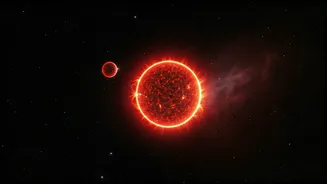
companion star. This discovery is pivotal as it validates a long-held hypothesis about the star's characteristics. The Hubble observations enabled astronomers to scrutinize Betelgeuse's surrounding environment, eventually showing the signs of interaction between Betelgeuse and this other star. It gives strong evidence for the companion's existence, helping researchers better understand the complexities of stellar systems.
Detecting the 'Wake'
Pinpointing the wake, the track left by a star moving through space, was key to this breakthrough. Hubble's advanced capabilities allowed for the observation of subtle changes. Researchers were able to perceive the influence of the companion star's gravity and its effect on the surrounding gases and dust around Betelgeuse. The precise detection of the wake's patterns gave researchers the evidence they needed, ultimately validating prior theories. This process demonstrated how sensitive instruments can provide vital clues to the mysteries of celestial bodies.
Stellar System Dynamics
This companion star's discovery is a valuable insight into the dynamics of a binary star system. Binary star systems, where two stars orbit each other, are widespread across the galaxy. The companion star influences Betelgeuse in various ways, ranging from gravitational effects to impacting the red giant's lifespan. By studying this interaction, astronomers learn more about how stars evolve, how they interact, and how these relationships shape the cosmos. This finding supports a deeper understanding of stellar evolution and the lifecycle of stars, including our sun.
Hubble's Unmatched Role
The Hubble Space Telescope again proved its crucial role in astronomical research. Its capacity to capture images with extraordinary detail and clarity has revolutionized space exploration, from the farthest galaxies to celestial bodies within our solar system. The Betelgeuse observation shows Hubble's continued value, and the data gathered contributes to better models of the universe. Its instruments let scientists study distant celestial objects, opening doors to previously inaccessible insights. This remarkable discovery underscores the importance of continued space-based research.
Implications and Future
The recognition of a hidden companion star around Betelgeuse delivers considerable implications for scientific research. This revelation has changed the way astronomers view red giants, and further study is expected to enhance our knowledge of stellar behavior. Future investigations will likely concentrate on the specific characteristics of the companion and its influence on Betelgeuse's destiny. The continuous data from Hubble and other telescopes will contribute to a more profound understanding of space.