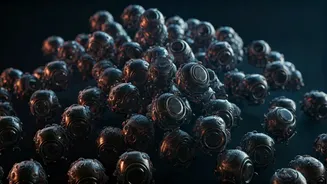

Microscopic Marvels
Microrobots, defined as robots smaller than a millimeter, represent a significant leap in technological miniaturization. These minuscule devices are engineered
to perform complex tasks in environments where larger robots or human intervention is impractical or impossible. These robots use onboard sensors and processing units, enabling them to make decisions and respond to their surroundings. Their small size grants unique advantages, especially in areas where access is limited, such as in the human body or within intricate industrial systems. Their autonomous nature allows them to perform their functions with limited human oversight, significantly increasing their potential for various applications.
Sensing and Acting
Despite their diminutive size, microrobots possess impressive capabilities in sensing and actuation. Equipped with a suite of tiny sensors, these robots can gather data from their surroundings, including information on temperature, pressure, and chemical composition. This data is then processed by onboard microprocessors, enabling the robots to analyze their environment and make informed decisions. Actuation mechanisms are also incredibly sophisticated, with various methods for movement and manipulation. Some use tiny motors, while others utilize innovative techniques like magnetic fields or microfluidics to navigate and interact with their environment. The ability to both sense and act allows microrobots to perform complex tasks, paving the way for revolutionary applications across various fields.
Future Applications Emerge
The potential applications of microrobots are vast and varied, promising significant impacts across multiple sectors. In healthcare, they offer new possibilities for minimally invasive diagnostics and targeted drug delivery, allowing for more precise and effective treatments. Within manufacturing, these robots could enhance precision and automation in tasks such as assembling micro-components. Microrobots are also expected to play a crucial role in environmental monitoring, allowing for efficient detection of pollutants and other hazardous substances. As research continues and technology advances, the capabilities of microrobots will continue to expand, ushering in an era of unprecedented possibilities in fields that previously seemed unreachable.