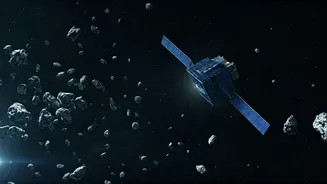







A Busy Year
The year 2025 marked a monumental period in space exploration, witnessing the highest volume of satellite launches ever recorded since the dawn of the space age.
Across the globe, there were an astounding 328 launch attempts, with a remarkable 315 of these proving successful. These missions collectively placed a significant number of new operational satellites into orbit, totaling 4,198 known assets. This surge in activity, while a testament to human ingenuity and ambition in space, also introduced new challenges, particularly concerning the growing issue of space debris and the potential for catastrophic collisions.
Collision Alert Surge
The dramatic increase in satellites operating in Earth's orbit during 2025 directly translated into a heightened risk of collisions. For Indian satellites specifically, this risk materialized as an overwhelming number of alerts. The Indian Space Situational Awareness Report for 2025, a crucial document detailing the state of our space assets, revealed that the Combined Space Operations Center (CSpOC) of the US Space Command issued more than 150,000 alerts to ISRO's Earth-orbiting satellites. This staggering figure underscores the sheer volume of close encounters and potential threats that our space infrastructure had to navigate throughout the year.
Collision Avoidance Maneuvers
To mitigate the escalating threat of space debris, ISRO implemented a series of critical collision avoidance maneuvers (CAMs) for its satellite fleet. Four such maneuvers were performed for satellites in Geostationary Orbit (GEO), a region where satellites maintain a fixed position relative to a point on Earth. In the more densely populated Low Earth Orbit (LEO), the situation was even more active, with 14 CAMs executed. Notably, one of these crucial maneuvers involved NISAR, a collaborative mission between NASA and ISRO, which NASA designates as a Risk Mitigation Maneuver. In many instances, where possible, ISRO creatively integrated collision avoidance requirements into routine orbit maintenance operations, thereby avoiding the need for dedicated, separate CAMs and ensuring the continued safety and operational integrity of its valuable space assets.