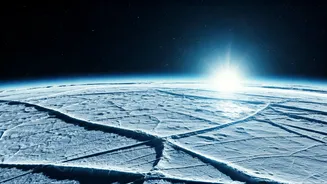

Europa's Icy Shell
Europa's surface, a vast expanse of ice, has always fascinated scientists. The smooth appearance with minimal impact craters, suggests it's relatively
young and constantly changing. This implies geologic activity. One of the most prominent features is the spider-like scar. This indicates that cracks on the surface allow salty water from a subsurface ocean to reach the surface. This is because the scar has a distinct pattern of crisscrossing lines, giving it the appearance of a spider's web. The presence of water and the potential for hydrothermal vents makes Europa a prime location to search for extraterrestrial life within our solar system. The interaction of the ice shell with the subsurface ocean is believed to be the primary driver of the moon's surface features.
Subsurface Ocean Evidence
The existence of a subsurface ocean on Europa has long been hypothesized. Gravitational data and other remote sensing techniques provided strong clues of an ocean under the ice. Now, the spider-like scar adds to that growing body of evidence. The spider scar's features suggest that this is due to upwelling of water from below. There is a possibility that cracks in the ice shell allow the ocean to interact with the surface. The detection of these materials, like salts, in these cracks further strengthens the theory. Studying the scar's composition offers invaluable information regarding the ocean’s composition, salinity, and the potential existence of hydrothermal vents, which could host a thriving ecosystem. This evidence paints a picture of a dynamic world where the icy surface interacts with a vast, liquid ocean below.
Geological Activity Unveiled
Europa's geology has become a focus of study because it plays a key role in understanding the moon's history and potential for life. The presence of these spider scars is a clear indication of ongoing activity. The cracks indicate a dynamic interplay between the ice shell and the subsurface ocean. Scientists are keen to understand the mechanisms behind the formation of features like these scars, which include tidal forces from Jupiter, along with the moon's internal heat. Such features also show the exchange of materials between the surface and the ocean below. Analyzing the composition of surface features may help reveal important information about the chemical environment of the subsurface ocean. This research is also being used to create models of Europa's structure, which further enhances our understanding of the moon's internal processes.
Potential for Life
The existence of a subsurface ocean makes Europa an ideal place to search for life. It is believed that the ocean could contain hydrothermal vents similar to those found on Earth. These vents can produce heat and chemical energy, forming unique ecosystems independent of sunlight. This environment offers suitable conditions for life. If Europa hosts these hydrothermal vents, the possibilities of discovering microbial life forms becomes more realistic. This exciting possibility has motivated ongoing and future missions to explore Europa. Space agencies are developing probes and landers designed to study the moon's surface and potentially access its subsurface ocean. If proven, this would have profound implications for our understanding of life in the universe, suggesting that life may be more widespread than we previously thought.
Future Missions & Studies
Several upcoming missions are focused on Europa. These missions include the Europa Clipper, designed to fly past the moon multiple times to collect data. The Europa Clipper mission is equipped with sophisticated instruments. These instruments will enable scientists to understand the composition of the surface and investigate the subsurface ocean's potential habitability. Scientists are looking forward to analyzing the icy surface. They will also be looking for plumes of water. They will also investigate its geological activity. These missions will provide detailed data about Europa's chemical composition. The data should provide the researchers with an understanding of the ocean's properties. These missions will not only increase our understanding of Europa's past but also its potential for hosting life in the future.