


Space Meets Time
Imagine a universe where the familiar dimensions of space – length, width, and height – are not solitary concepts but are intimately bound with the dimension of time.
This revolutionary idea, known as spacetime, proposes a four-dimensional framework for our cosmos. Instead of simply asking 'where' an event occurs, spacetime incorporates the crucial element of 'when.' This integration might seem abstract, but it's fundamental to understanding many observed cosmic phenomena. It suggests that our experience of the universe isn't just about location but also about the flow of existence itself, a concept that underpins much of modern physics and our perception of reality.
Speed's Temporal Effect
One of the most mind-bending consequences of the spacetime model is how an object's velocity influences its journey through time. While imperceptible in our everyday lives due to our relatively slow speeds, this effect becomes significant at velocities approaching the speed of light. The faster an object travels through space, the slower it traverses time. This phenomenon, known as time dilation, means that a clock attached to a rapidly moving object will tick at a slower rate compared to a stationary clock. It's as if motion itself stretches or compresses the passage of time, a direct outcome of space and time being interwoven.
Massive Objects and Gravity
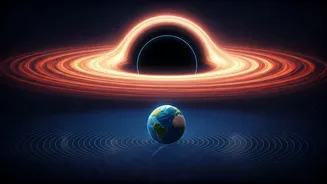
The spacetime model also provides a profound explanation for gravity. Rather than a mysterious force pulling objects together, gravity arises from the curvature of spacetime itself. Physicists often liken spacetime to a flexible fabric. When massive objects are introduced, they create a 'dent' or warp in this fabric. Other objects, following the contours of this warped spacetime, appear to be drawn towards the massive object – this is what we perceive as gravitational attraction. Crucially, this warping isn't limited to space; it affects time as well. Near extremely massive celestial bodies, where gravity's influence is strongest, time itself slows down, a direct consequence of spacetime distortion.
Spacetime in Fiction
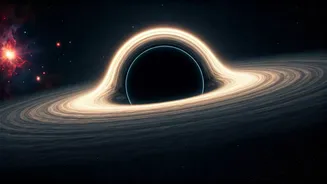
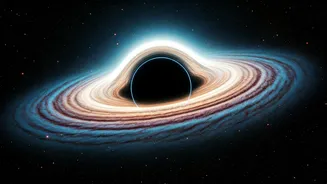
The compelling implications of spacetime's curvature and time dilation have captured the imagination of storytellers, most notably in science fiction. The 2014 film 'Interstellar' vividly illustrates these principles through its depiction of astronauts venturing near a colossal black hole. The intense gravitational pull of this celestial behemoth dramatically slows time on a nearby planet. The narrative highlights how a mere hour spent on this world equates to seven years passing on Earth, a dramatic and fictionalized yet scientifically grounded example of how extreme gravitational fields can manipulate the passage of time due to the very fabric of spacetime.
Everyday Spacetime Impacts
The intricate dance of spacetime isn't confined to distant planets or cinematic fantasies; it subtly influences our daily lives, particularly through the technology we rely on. The global positioning system (GPS) is a prime example. Satellites orbiting Earth are constantly in motion, traversing vast distances through space each second. This velocity causes their internal clocks to tick approximately 7 microseconds slower each day compared to clocks on Earth, a direct manifestation of time dilation. Furthermore, the reduced gravitational field experienced by satellites in orbit causes their clocks to gain about 45 microseconds daily. Engineers meticulously account for both these effects, which combine for a net difference of 38 microseconds per day, ensuring that satellite navigation remains accurate and synchronized with ground-based systems.
Gravitational Waves
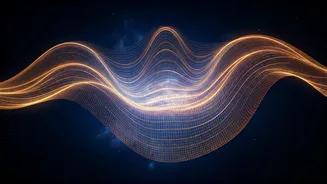
Beyond its impact on time and gravity, spacetime is also a medium through which cosmic events send ripples. These disturbances, known as gravitational waves, are like tremors in the fabric of spacetime, generated by cataclysmic occurrences such as the collision of black holes or neutron stars. The detection of these waves has opened up an entirely new window into observing the universe. By studying these faint signals, scientists have been able to glean profound insights into some of the most ancient and mysterious objects in the cosmos, including black holes, offering direct evidence of spacetime's dynamic and responsive nature.