
The Enigmatic Puzzle
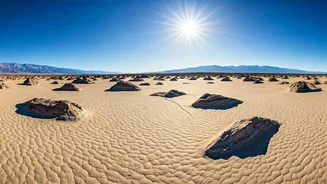
The 'sliding rocks' of Death Valley, a true geological puzzle, have captivated the scientific community for years. These rocks, ranging in size, traverse
the Racetrack Playa, leaving behind distinct trails in the mud. The mystery lay in how these heavy stones could possibly move across a seemingly flat surface without any apparent assistance. Various theories emerged over time, each attempting to explain the phenomenon, but none could definitively provide a comprehensive answer. The challenge was complicated by the remote location and the unpredictability of the events. The lack of direct observation further fueled the enigma, making the correct explanation exceedingly difficult to pinpoint. The allure of the unknown kept scientists and curious individuals alike engrossed in the mystery.
Rare Conditions Unveiled
Scientists finally cracked the code, pinpointing a specific combination of conditions. The process hinges on the formation of ice. When temperatures drop low enough, thin sheets of ice form on the playa's surface. As the sun rises, the ice melts, breaking into small floating panels. With just the right amount of wind, these floating ice sheets, acting like sails, get caught behind the rocks. This setup creates enough force to start the rocks sliding. The study also showed that a combination of factors must be perfect. If the water freezes too thick, the rocks can't move. If there isn't enough wind, the rocks remain still. And if the ice melts completely, there is no more driving force. This delicate balance of freezing and thawing, combined with the right wind speed, is the key to understanding the sliding rocks.
Ice and Wind's Role
The crucial roles played by ice and wind are essential to understanding the movement. The thin ice acts as a facilitator, reducing friction between the rocks and the playa's surface, as the ice sheets partially lift the rocks. Wind then becomes the primary driving force. The wind's gentle push is amplified by the presence of the ice panels, which act like sails, creating additional leverage. This interplay of forces allows the rocks to glide across the playa. Moreover, the direction and strength of the wind dictate the direction and speed of the movement. Researchers meticulously studied the varying wind patterns to correlate them with the tracks' direction. It confirmed that the wind, combined with the presence of ice, provides the necessary force to move the rocks over the surface of the playa.
Decades-Long Mystery Solved
This discovery concluded the long scientific quest to understand this geological enigma. Researchers, using advanced tracking methods and environmental monitoring, were able to observe the sliding rocks in action. They placed GPS devices on some rocks, monitoring their movement. The data gathered, confirmed the importance of ice and wind. This breakthrough is a testament to the power of persistence in scientific inquiry. It also emphasizes the importance of understanding the planet's environments, from the common to the most extraordinary. This revelation gave insights into the complex interactions of natural forces, providing a clearer understanding of the forces that shape our planet. This research opened new paths for scientists to study other unexplained natural occurrences.