








AI’s Cosmic Role
AI is changing how NASA searches for life in outer space. Scientists are now using sophisticated algorithms to sift through enormous amounts of data gathered
from various space missions. This includes analyzing data from telescopes, space probes, and even the International Space Station (ISS). One crucial application is in identifying potentially habitable environments, such as those found on Europa, a moon of Jupiter, where scientists suspect a subsurface ocean might exist. AI helps analyze the conditions of these environments, including the presence of water, temperature, and chemical composition, to determine if they could support life. Furthermore, AI systems are trained to recognize patterns in data that might indicate the presence of extraterrestrial life. This includes analyzing radio signals, identifying unusual spectral signatures, and detecting complex molecules in the atmospheres of distant planets. By automating these complex tasks, AI enables scientists to process information faster and more efficiently than ever before, dramatically increasing the chances of finding life beyond Earth.
Europa's Ocean Mystery
One of the most exciting areas of AI's application is the study of Europa. Scientists have long suspected that a vast, salty ocean lies beneath its icy surface, and recent research is supporting the idea that this ocean could contain the right conditions to support life. AI algorithms are used to analyze data about the moon's surface composition, radiation levels, and potential pathways for water movement. These algorithms can identify the most promising locations for finding evidence of life. Furthermore, AI helps in simulating complex scenarios, such as the interaction between the ice shell and the ocean below. It can model how heat and chemicals move through the system, creating a better understanding of the possible conditions within Europa's ocean. Sinking salty ice is one key factor that may be providing the pathways for life-sustaining conditions. Such data will be invaluable as NASA prepares future missions to Europa, including missions designed to explore its ocean and search for signs of life. The data produced with the help of AI also allow scientists to be more effective in their search.
SPHEREx and Data
NASA’s SPHEREx mission is set to revolutionize our understanding of the cosmos by mapping the entire sky in infrared light. This ambitious project will collect a vast amount of data, which AI will be crucial in processing and analyzing. The data gathered by SPHEREx will provide detailed information about the formation of galaxies, the presence of dark matter and dark energy, and the characteristics of exoplanets. AI algorithms will be used to identify patterns and anomalies in this data, allowing scientists to gain new insights into the universe. The mission’s all-sky map will be shared with the world, thus enabling the scientific community to analyze the results from SPHEREx. Moreover, AI will help to distinguish between real signals and noise, as well as identify potentially habitable exoplanets and regions where life might be possible. The SPHEREx mission, combined with the power of AI, promises to open up new frontiers in astronomy and cosmology, ultimately enhancing our knowledge of the universe and our place within it.
Space Station Experiments
The International Space Station (ISS) serves as an invaluable laboratory for scientists. Experiments conducted on the ISS are crucial for understanding the impact of space environment on living organisms, including bacteria and phages. AI is utilized to analyze the results of these experiments. These results often provide vital data about mutations and adaptations that occur in space. For example, researchers discovered that phages and bacteria accumulated distinctive mutations during their time on the ISS. The research allows us to understand how life can evolve in extreme conditions, which is crucial for the search for life elsewhere in the universe. Scientists can predict the possible adaptations of life forms on other planets. This includes modeling how these organisms might interact with different environments and how they might respond to various challenges. The insights gained from these experiments provide valuable information to understand the potential habitability of other planets.
Artemis II and Exploration
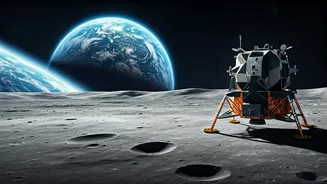
NASA's Artemis program is a critical step in the future of space exploration. The upcoming Artemis II mission, specifically, will have important implications for future endeavors. The mission will take astronauts around the moon, offering crucial data on lunar science operations. AI is helping in designing and analyzing the Artemis II mission. This includes predicting the best landing sites for future missions and optimizing the design of lunar habitats. AI will also analyze data collected by the Artemis II mission to learn more about the moon's geology and composition, thus aiding in the development of sustainable space operations. The Artemis program aims to establish a long-term presence on the moon, which will act as a launchpad for future missions to Mars and beyond. AI will support the program by providing solutions to a number of challenges, including creating reliable life support systems, enhancing the protection of astronauts from radiation, and optimizing the use of lunar resources. This comprehensive approach is vital for ensuring the success of Artemis and future space exploration initiatives.