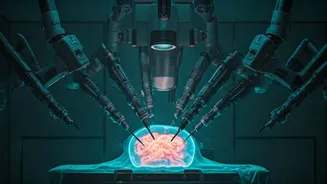

Mind-Controlled Prosthetics
Imagine controlling a prosthetic limb simply by thinking about it. This isn't a futuristic fantasy anymore. Scientists are making incredible strides in mind-controlled
prosthetics. These devices utilize brain-computer interfaces to translate neural signals into movements, allowing users to regain control and functionality. Advanced systems are even providing sensory feedback, allowing the user to 'feel' the environment. Research is focused on improving accuracy, reducing invasiveness, and enhancing the range of motion. The goal is to create prosthetics that seamlessly integrate with the body, improving the quality of life for individuals with limb loss or paralysis. This technology moves closer to the dream of bionic human beings, blurring the lines of imagination and technology.
Hyperloop Transportation
Forget traffic jams and long commutes. The Hyperloop concept envisions high-speed transportation via pods traveling in low-pressure tubes. This system promises speeds exceeding 700 mph, potentially revolutionizing travel. Several companies are actively developing Hyperloop technologies, with test tracks and pilot projects already underway. The core idea is to reduce friction and air resistance, enabling rapid and energy-efficient transit. Challenges remain, including the construction of the extensive infrastructure, safety regulations, and the economics of such a system. The potential benefits are enormous, including reduced travel times, decreased carbon emissions, and the transformation of urban planning. Hyperloop could reshape the way people and goods move across the globe, bringing cities closer together and opening up new possibilities for exploration.
3D-Printed Organs
The field of regenerative medicine is making remarkable strides with 3D-printed organs. This innovative approach involves using bio-printers to create functional organs from a patient's own cells. This technology promises to overcome the limitations of organ donation, providing a readily available supply of replacement organs. Scientists are working on printing complex structures, including hearts, kidneys, and livers. The process involves creating a 3D model of the organ, using bio-ink (a mixture of cells and biomaterials), and then 'printing' the organ layer by layer. Challenges include ensuring the survival of cells, creating functional blood vessels, and ensuring long-term viability. The implications are revolutionary, potentially eliminating the need for organ donors, and revolutionizing medicine by creating personalized organs designed to fit patients perfectly.
Exoskeletons for Enhancement
Exoskeletons are no longer confined to science fiction; they are becoming a reality for a range of applications. These wearable devices provide support and enhance human capabilities, offering assistance to people with mobility issues, and also augmenting strength and endurance for industrial or military use. Exoskeletons use motors and sensors to assist with movement, allowing users to lift heavy objects, walk for extended periods, or perform repetitive tasks with less strain. Developments include lighter, more efficient designs, powered by batteries or other energy sources. These technologies are being used in industries, healthcare, and military applications, and show great promise in improving quality of life and redefining human limits. The rise of exoskeletons demonstrates the convergence of technology and the human body, paving the way for a more augmented future.
Quantum Computing Reality
Quantum computing is rapidly moving from theory to practice, with major implications for fields such as medicine, materials science, and artificial intelligence. Unlike classical computers, which use bits to store information as 0 or 1, quantum computers use qubits. Qubits can exist in a superposition of states, allowing them to perform exponentially more calculations simultaneously. This enables complex simulations and data analysis that are impossible for current computers. Companies and research institutions are racing to build quantum computers with increasing processing power. Although still in its early stages, quantum computing has the potential to revolutionize drug discovery, financial modeling, and the development of new materials. Its impact on fields needing massive computing power will be transformative, ushering in a new era of technological advancement and discovery.
Lab-Grown Meat
The concept of lab-grown meat, also known as cultivated meat, has moved from a theoretical idea to tangible products undergoing rapid development. This innovative technology involves growing meat from animal cells in a laboratory setting, eliminating the need for traditional animal agriculture. This approach promises a more sustainable and ethical way to produce meat, with reduced environmental impacts and animal welfare concerns. Scientists are working to optimize cell culture techniques, develop cost-effective production methods, and replicate the taste and texture of conventional meat. The first lab-grown meat products have already been developed and are starting to gain regulatory approval in some countries. The industry's expansion has the potential to reshape the global food system by minimizing the environmental footprint and also addressing ethical concerns associated with meat production.
Advanced Robotics Development
Robotics is experiencing an unprecedented period of advancement, with robots becoming increasingly sophisticated and versatile. From robots capable of performing complex surgical procedures to those that can work alongside humans in manufacturing environments, the field is evolving. Recent advances include improved artificial intelligence, enhanced dexterity, and increased autonomy. These advancements allow robots to perform a wider array of tasks in various industries, including healthcare, manufacturing, and logistics. Robots are being developed to explore dangerous environments, assist the elderly, and even become companions. Ongoing research focuses on improving robot adaptability, enhancing human-robot collaboration, and ensuring safety. The evolution of robotics suggests a world where robots seamlessly integrate into our lives, transforming industries, enhancing productivity, and improving quality of life.
Space-Based Solar Power
The idea of harvesting solar energy in space and beaming it back to Earth is no longer a fantasy. Space-based solar power systems could capture sunlight without the interference of weather or night, potentially providing a constant and abundant source of clean energy. The concept involves placing solar arrays in orbit, collecting solar energy, and transmitting it wirelessly to receiving stations on Earth. Several countries and companies are actively developing the technologies needed for space-based solar power, including large-scale solar arrays, efficient energy transmission systems, and safe receiving stations. Challenges include the high cost of launching and maintaining the infrastructure in space, but the potential benefits are enormous. It could provide a sustainable energy source, reducing reliance on fossil fuels and mitigating climate change. This technology represents the fusion of space exploration with environmental sustainability, offering a vision for the future of energy production.