




Close Encounter Details
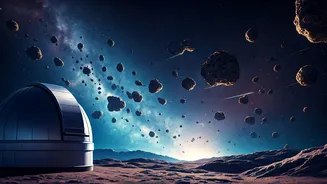
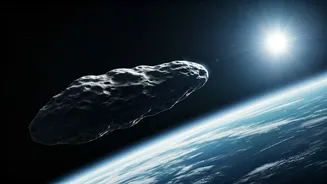
On April 9th, an asteroid designated 2026 GD, roughly the size of a common house, traversed a path remarkably close to Earth. This celestial visitor came
within a distance of approximately 156,000 miles (about 251,000 kilometers). To put this into perspective, this is a considerably closer proximity than the average distance of the Moon from our planet, which hovers around 239,000 miles. Therefore, the asteroid's trajectory placed it in the space between Earth's orbit and the Moon's orbit. While such a close passage might initially sound alarming, it's important to note that this specific event was deemed entirely safe, posing no risk of impact or disruption to Earth.
Understanding the Threat Level
Asteroid 2026 GD, with its diameter estimated at about 54 feet, falls into the category of smaller near-Earth space objects. This classification means it's not considered a significant threat. NASA has confirmed that this asteroid is not categorized as hazardous, and its orbital path does not intersect with Earth's trajectory. For an asteroid to be deemed potentially dangerous, it generally needs to possess a much larger mass and follow a path that would bring it much closer to our planet over time, potentially leading to a collision course. Such close approaches by smaller objects are relatively common and often go unnoticed by the public unless they produce a visible spectacle in the night sky.
Importance of Constant Vigilance
The continuous tracking of objects like Asteroid 2026 GD is a vital component of a broader, ongoing effort to map, understand, and catalog near-Earth space. These ongoing observations are instrumental in refining orbital predictions, enhancing our knowledge of potential future threats, and developing sophisticated planetary defense systems. Each observed asteroid adds valuable data that contributes to the ongoing quest to safeguard Earth from any potential impacts. Beyond the immediate concern of planetary defense, these observations also serve a crucial scientific purpose, offering insights into the formation and early history of our Solar System, as many asteroids are remnants from that primordial era.