





A Cosmic Observer
The James Webb Space Telescope (JWST), a collaborative project between NASA, the European Space Agency, and the Canadian Space Agency, has become a pivotal
tool in astronomical research. Its advanced infrared capabilities enable it to peer through cosmic dust and observe distant objects with unprecedented clarity. The telescope’s ability to detect the faint light from the earliest galaxies and exoplanets has transformed our understanding of the universe. With its advanced instruments, JWST can analyze the chemical composition of exoplanet atmospheres, providing crucial information about their potential habitability and the processes shaping these distant worlds. Its contributions extend from studying the formation of stars and galaxies to observing the atmospheres of exoplanets, making it a cornerstone of modern astrophysics. It continues to reshape our comprehension of the cosmos.
Exoplanet Atmosphere Unveiled
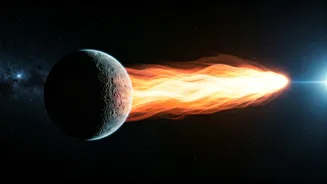
JWST's observation of an exoplanet losing its atmosphere is a landmark achievement. The telescope detected a massive stream of helium escaping from the planet's atmosphere, providing direct evidence of atmospheric erosion. This phenomenon is caused by stellar winds, energetic particles emitted by the host star, that strip away the atmospheric gases over time. The rate of atmospheric loss varies based on the planet's size, distance from its star, and the intensity of stellar radiation. These observations show how the atmospheres of exoplanets can evolve over time, potentially impacting their ability to support life. This discovery allows scientists to model how atmospheres change under stellar influence, thereby understanding the survivability of exoplanets.
Helium Stream Insights
The detection of a helium stream escaping from the exoplanet's atmosphere offers critical insights into the underlying processes. Helium, being a light gas, is easily expelled from planetary atmospheres, making it a key indicator of atmospheric loss. JWST's capacity to identify this helium stream allows scientists to gauge the speed and intensity of the atmospheric loss. Scientists use this data to model how a planet's atmospheric composition changes, revealing which gases remain, and which are lost to space. Further investigation could also reveal whether the exoplanet had a denser atmosphere in the past or if it has lost significant amounts over billions of years. This data is critical for assessing the long-term habitability of the exoplanet, as atmospheric erosion can make the planet's surface uninhabitable.
Implications for Habitability
The findings from JWST highlight significant implications for the possibility of life on exoplanets. The rate of atmospheric loss affects the potential for a planet to sustain a stable climate and liquid water on its surface, which are essential for life as we know it. A planet that loses its atmosphere may experience drastic temperature changes and become inhospitable. Studying atmospheric erosion can help predict the longevity of the habitable zones around stars and assess whether a planet can maintain its atmospheric components over vast stretches of time. These insights will help refine the criteria used in the search for habitable worlds. With better understanding of atmospheric loss, scientists can focus their efforts on exoplanets that show greater potential for supporting life.
Future Research Avenues
The JWST's observations have opened up exciting avenues for future research. Scientists are eager to study a larger sample of exoplanets using JWST to discern patterns in atmospheric erosion. They are also developing more detailed models of atmospheric dynamics. Future studies could include in-depth analysis of the chemical compositions of exoplanet atmospheres, including the identification of other gases. Moreover, there is interest in comparing the atmospheric conditions of different exoplanets to develop a thorough picture of how they evolve over billions of years. This multi-faceted approach will improve our understanding of exoplanet atmospheres and our search for potentially habitable worlds.