







Peering Inside the Sun
Harnessing the power of helioseismology, a technique akin to using earthquakes to study Earth's interior, researchers have made a significant advance in understanding
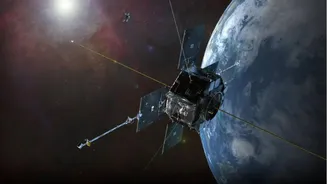
the Sun's internal dynamics. By meticulously analyzing over a decade's worth of data from NASA's Solar Dynamics Observatory, specifically focusing on readings from the Helioseismic and Magnetic Imager (HMI), they scrutinized more than 5,000 days of observations. This extensive study allowed them to detect two faint types of waves propagating through the Sun's outer layers. These observed wave patterns bear a striking resemblance to theoretical 'magneto-Rossby waves,' complex phenomena that emerge in rotating fluids where magnetic fields and fluid motion interact profoundly. This detection marks a potential breakthrough in observing processes previously confined to theoretical models.
Unveiling the Magnetic Doughnut
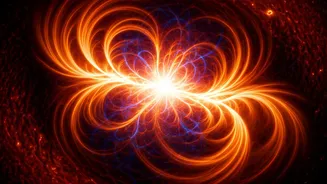
The newly identified waves appear to originate just below the Sun's visible surface, within the turbulent convection zone. This region is characterized by vigorous upwelling and downwelling of superheated plasma, a fundamental process that transports heat outwards towards space. The distinct patterns observed in these solar waves strongly suggest the presence of an enormous, torus-shaped magnetic field situated deep within the Sun. While this magnetic structure might be relatively weak at the solar surface, it is theorized to possess considerable strength in the Sun's denser interior. This internal magnetic architecture is exceptionally important as it is intrinsically linked to the solar cycle, the roughly 11-year ebb and flow of solar activity that dictates the Sun's energetic output.
Impact on Earthly Systems
The implications of understanding the Sun's internal magnetic field are profound for life and technology on Earth. Intense solar activity can trigger phenomena like solar flares and coronal mass ejections, which hurl charged particles into space. These energetic events can wreak havoc on our technological infrastructure, disrupting satellites, scrambling communication systems, interfering with navigation signals like GPS, and even destabilizing power grids. The challenge in directly observing the intricate physics driving the solar cycle has historically hampered accurate forecasting. However, these newly detected magnetic waves offer a promising new avenue for real-time monitoring of internal solar processes, potentially enabling more precise estimations of the magnetic field's intensity and characteristics.
Towards Better Forecasts
This significant discovery helps bridge a long-standing gap between theoretical predictions and direct observations of solar activity. For years, scientists have posited the existence of large-scale magnetic waves within the Sun, but their direct detection proved exceedingly difficult. This new evidence provides a tangible glimpse into the hidden mechanisms that govern the Sun's magnetism. As research progresses and more solar data is analyzed, these findings hold the promise of significantly enhancing our ability to forecast solar storms. While it's still early days, and further investigation is required before definitive predictive capabilities can be claimed, the ability to track these waves and infer the evolution of the Sun's internal magnetic field could revolutionize our anticipation of future solar cycles and their potential impacts.