






Pharaohs' Tomb Raids
Recent discoveries, particularly hundreds of funerary figurines, are shedding new light on a surprising practice among ancient Egyptian pharaohs: the appropriation
of other rulers' tombs. This suggests that powerful rulers did not always build their own final resting places from scratch but instead re-purposed and possibly even desecrated the tombs of their predecessors. The presence of these figurines within a tomb not originally intended for the interred individual hints at a complex system of succession and power assertion, where a pharaoh might literally take over the afterlife provisions of another. This practice challenges conventional notions of dynastic succession and highlights the lengths to which rulers would go to secure their eternal legacy, even if it meant erasing the memory of those who came before them. The detailed study of these artifacts provides tangible evidence of historical events that were previously only speculated upon, offering a unique glimpse into the political and spiritual landscape of ancient Egypt.
Pyramid Mysteries Unveiled
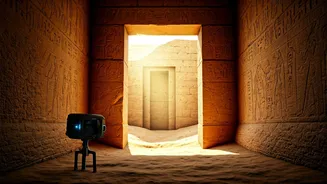
Intriguing anomalies detected within the Great Pyramid of Giza have sparked considerable excitement among archaeologists and scientists. These unusual readings suggest the potential presence of an unknown entrance or chamber concealed within the monumental structure. Advanced scanning techniques, likely employing non-invasive methods such as muon tomography, have identified voids or areas of differing density that do not align with the known internal architecture of the pyramid. This discovery fuels speculation about undocumented construction phases or hidden passages that may have served specific purposes, perhaps related to the burial rituals or the original construction process. The implications are significant, as such a finding could redefine our understanding of the pyramid's design, construction techniques, and potentially reveal new insights into the beliefs and practices of the ancient Egyptians who built it. Further investigation is crucial to confirm these anomalies and understand their full meaning.
Tutankhamun's Mummy Mishap
The historic discovery of King Tutankhamun's tomb in the early 20th century was a landmark event, but subsequent handling of his mummy involved methods that were both drastic and, in retrospect, controversial. Compelled by the desire to study the pharaoh's remains more closely and perhaps preserve them, researchers resorted to using 'hot knives and brute force' to extract the mummy from its gilded coffin. This aggressive approach led to the decapitation and dismemberment of the mummified body. Astonishingly, after these procedures, the researchers made an effort to conceal the extent of the damage they had inflicted. This account reveals the difficult ethical dilemmas faced by early archaeologists and conservators, balancing scientific curiosity with the preservation of precious historical artifacts. The cover-up also highlights a period where the methods of preservation and study were still evolving, and the full impact of such actions on the integrity of the mummy was not fully appreciated.
Ancient Military Fortifications
Archaeological excavations in the Sinai Desert have brought to light well-preserved ancient Egyptian military structures, including barracks dating back 3,500 years. These findings offer a tangible connection to the military might and logistical capabilities of ancient Egypt. Within these fortifications, archaeologists have uncovered ancient ovens, suggesting the systematic provision of food for soldiers, and remarkably, fossilized dough. The presence of these elements provides invaluable insights into the daily life of soldiers stationed at these outposts and the operational effectiveness of the Egyptian army. Furthermore, a tree-lined walkway leading to one of these fortresses has been unearthed, indicating a planned and organized approach to military infrastructure. One sword found at a 3,200-year-old site bears an inscription of 'Ramesses II', directly linking the fortress to the reign of this prominent pharaoh and underscoring its strategic importance during his rule. These discoveries paint a vivid picture of Egypt's frontier defenses and its organized military presence.
Sun God's Valley Temple
A significant excavation in an ancient Egyptian valley temple has revealed its connection to a much larger upper temple dedicated to Ra, the revered sun god. This discovery underscores the profound importance of solar worship in ancient Egyptian religion and the architectural scale dedicated to it. The valley temple, often serving as an entrance or ceremonial space, is now understood as a crucial component of a grander religious complex. The link between these two structures suggests a deliberate design intended to facilitate rituals and processions that honored Ra, potentially integrating earthly activities with celestial observation. Such large-scale temple complexes were central to the religious and political life of ancient Egypt, serving as focal points for worship, economic activity, and royal authority. The excavation of this connected temple system provides crucial data for understanding the evolution of religious architecture and the power wielded by priests and pharaohs associated with the cult of the sun god.