




Year of Lunar Wonders
The year 2026 promises an extraordinary astronomical display with a total of thirteen full moons gracing our skies. Among these, observers can anticipate
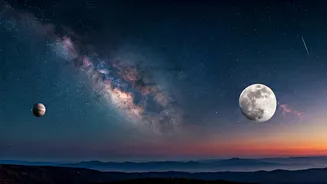
three Supermoons, which appear larger and brighter due to their closer proximity to Earth, and two significant lunar eclipses. Notably, one of these eclipses will be a total lunar eclipse, a rare and breathtaking phenomenon that won't be seen again until New Year's Eve 2028. While seasoned stargazers recognize that the absolute best time for observing the moon's surface details, even with optical aid, is not precisely on the night of the full moon, the visual spectacle of a perfectly orbited moon ascending at dusk offers an unparalleled celestial vista that remains a highlight for skywatchers worldwide.
January to March Delights
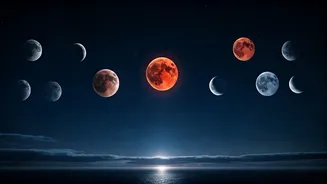
The lunar journey of 2026 commences on Saturday, January 3rd, with the Wolf Moon, which also happens to be a Supermoon, appearing at 10:02 UTC (5:02 a.m. EST). Following this, Sunday, February 1st, brings the Snow Moon, visible at 22:09 UTC (5:09 p.m. EST). March is particularly noteworthy, as Tuesday, March 3rd, hosts the Worm Moon at 11:37 UTC (6:37 a.m. EST), coinciding with a total lunar eclipse. This 'blood moon' event, where the moon passes through Earth's umbra, will cast a distinct reddish hue and be observable for 58 minutes between 6:04 and 7:02 a.m. EDT, with prime viewing locations in western North America and the Asia Pacific. Western North America and the Asia Pacific will offer the most spectacular views of this reddish spectacle.
Spring and Summer Spectacles
As spring unfolds, April 1st, a Wednesday, presents the Pink Moon at 02:11 UTC on April 2nd (10:11 p.m. EDT on April 1st). May continues the celestial show with the Flower Moon on Friday, May 1st, at 17:23 UTC (1:23 p.m. EDT). The month concludes with an exciting event: Sunday, May 31st, hosts the Blue Moon, the second full moon within a single calendar month, at 08:45 UTC (4:45 a.m. EDT). Transitioning into summer, Monday, June 29th, features the Strawberry Moon at 23:56 UTC (7:56 p.m. EDT), which is also a micromoon, appearing slightly smaller. July's offering is the Buck Moon on Wednesday, July 29th, at 14:35 UTC (10:35 a.m. EDT).
Late Summer to Autumn Peaks
The latter half of the year begins with the Sturgeon Moon on Friday, August 28th, at 04:18 UTC (12:18 a.m. EDT), which will also be a partial lunar eclipse. During this event, approximately 96% of the moon will enter Earth's umbral shadow, potentially displaying a reddish-orange tint around its maximum eclipse at 12:12 a.m. EDT on August 28th. The best vantage points for this partial eclipse are across the Americas, Europe, and Africa. Autumn arrives with the Harvest Moon on Saturday, September 26th, at 16:49 UTC (12:49 p.m. EDT). Following this, the Hunter's Moon appears on Monday, October 26th, at 04:11 UTC (12:11 a.m. EDT).
Year's End and Special Moons
As 2026 draws to a close, the Beaver Moon graces the sky on Tuesday, November 24th, at 14:53 UTC (9:53 a.m. EST), marking the third Supermoon of the year. The year's final full moon is the Cold Moon, appearing on Wednesday, December 23rd, at 01:28 UTC on December 24th (8:28 p.m. EST on December 23rd), which is also designated as a Supermoon. The concept of a 'Blue Moon' refers to the second full moon occurring within a single calendar month, a fascinating occurrence that will be visible on May 31st in 2026. The 'Blood Moon' designation pertains to a total lunar eclipse, a visually dramatic event that transpires when Earth positions itself directly between the sun and moon, imbuing the lunar surface with a distinctive crimson glow.