


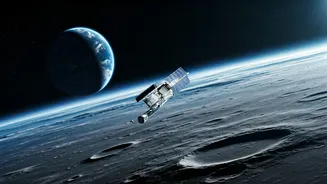

The Growing Orbital Menace
The expanse of space surrounding our planet is increasingly cluttered with orbital debris, a persistent concern for space agencies. This 'space junk' comprises
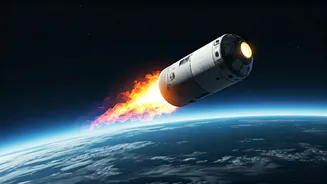
a vast array of objects, from defunct satellites to fragments shed by past space endeavors. The potential for cascading collisions, known as Kessler Syndrome, looms large, where one impact could trigger a chain reaction, generating even more debris and significantly heightening the risk of future encounters. Experts estimate that millions of objects larger than a centimeter, along with tens of millions of even smaller particles, populate Earth's orbit, moving at astonishing speeds, often exceeding 17,500 mph. This ever-present hazard underscores the challenges of maintaining safe passage through space.
Elusive Debris in Pictures
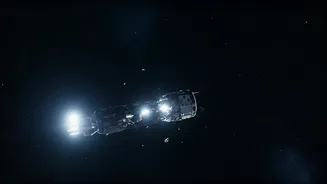
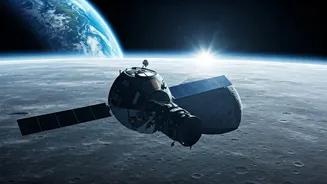
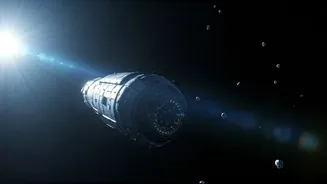
Despite the sheer volume of space junk, capturing it in photographs, even from missions like Artemis II, is extraordinarily rare. The primary reason is size; most debris fragments are simply too minuscule to be perceived by the human eye or clearly resolved by camera lenses. While there's a theoretical possibility of photographing a larger piece, the celestial conditions would need to be exceptionally precise. The immense velocities at which both the spacecraft and the debris are traveling create a significant challenge in obtaining a distinct, static image. The odds of a clear photograph depicting space junk are exceedingly slim, rendering it practically invisible in most imagery.
Altitude and Speed Matters
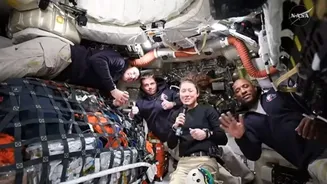
A crucial factor contributing to the elusiveness of space debris in photographs is its typical location. The densest concentrations of orbital debris are found in Low Earth Orbit, generally between approximately 466 and 621 miles above our planet's surface. During the critical initial phases of a space mission, such as the ascent of Artemis II, astronauts are intensely focused on vital flight operations. This intense concentration on immediate tasks leaves virtually no opportunity to divert attention to photograph external objects, even if they were readily visible. Moreover, the spacecraft's rapid transit through these orbital shells means that even larger objects would be difficult to identify, let alone capture with any detail, within the fleeting moments of observation.
Astronaut Safety Intact
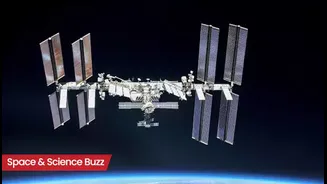
While space junk is notoriously difficult to photograph, its presence in human spaceflight is an ongoing reality. The International Space Station, for instance, routinely contends with the impact of minuscule debris particles. However, the station is engineered with robust systems designed to withstand such minor impacts, and the probability of encountering larger, more hazardous objects remains relatively low. Space agencies employ sophisticated tracking systems to monitor potential threats during crewed missions, ensuring that astronauts are aware of and protected from foreseeable dangers. Despite the seriousness of the space debris problem, the vastness of space means that objects are generally dispersed over immense distances, mitigating the constant threat of immediate collision.