



The AI Revolution Begins
The field of Artificial Intelligence has been rapidly evolving, with models consistently achieving remarkable results in diverse applications. These are
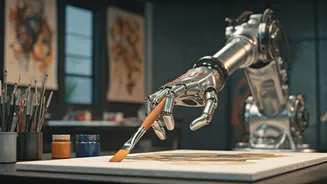
no longer limited to the mundane; AI has shown surprising abilities in tasks that require creativity and innovation, traditionally considered the sole domain of humans. The capacity of AI to generate text, compose music, and even create visual art has reached a stage where it can outperform many individuals. The creative capabilities of AI are proving to be a challenge to the traditional understanding of human uniqueness and skill, raising questions about what defines intelligence and how it can be measured.
Quantifying Creativity, AI Style
Measuring creativity is inherently difficult because it is subjective and multifaceted. The methods to assess AI's creative output involve a combination of quantitative and qualitative approaches. Experts use metrics like originality, fluency, and relevance to evaluate AI-generated content. These metrics are often compared against benchmarks such as the creative output of human participants in controlled studies. Furthermore, the use of large datasets of human-created content to train AI models allows for assessing the performance of AI by comparing its output against those datasets. The data suggests that AI-generated works are becoming increasingly competitive, often scoring at par or even exceeding average human performance in certain creative tasks.
Impact on Creative Industries
The advancement of AI's creative abilities introduces significant implications across various creative industries. For example, in marketing, AI can generate unique ad campaigns more quickly than human teams. In the music industry, AI models can now produce entire musical compositions, potentially changing the process of music creation. Similar changes can be observed in the film industry, where AI assists in writing scripts, designing visual effects, and even creating entire animated sequences. Though AI tools offer efficiency and cost benefits, there are also rising concerns about the potential displacement of human creatives and the need to adapt skills to collaborate with these new technologies. The development of AI-based tools can change the structure of creative teams, their functions, and their required skills.
Human Creativity's Future
AI’s increasing creative ability also leads to a discussion about the future role of human creativity. It's important to recognize that AI is a tool. Though it can be used to generate creative output, it still relies on the data and instructions provided by humans. This shifts the focus from simple content creation to the ability of humans to curate, direct, and innovate with AI tools. The future of human creativity will likely involve a blended approach, in which humans collaborate with AI systems to generate fresh ideas. This new age demands that humans concentrate on cultivating critical thinking, emotional intelligence, and inventive concepts that AI can then expand upon.
Ethical Considerations Emerge
As AI's creative abilities develop, so do the accompanying ethical considerations. One major concern is the issue of originality and copyright. Since AI models are trained on existing data, there's always the question of where the boundary lies between inspiration and outright imitation. Another concern is the potential for AI-generated content to spread misinformation or be used to manipulate public opinion. Additionally, the increasing reliance on AI can reduce the appreciation for human creative efforts, which requires an ethical approach to safeguard the value of human artistic creation. Responsible development and application of AI require transparency, accountability, and a commitment to upholding ethical standards to ensure that the technology benefits society without causing harm.