






The Trillion-Dollar Projection
Nvidia's chief executive, Jensen Huang, has confidently announced a monumental revenue target for the artificial intelligence chip leader, anticipating
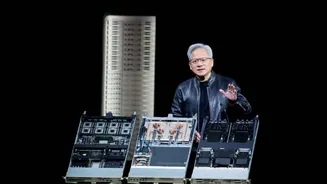
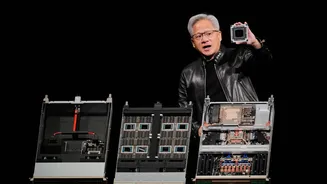
a haul of at least one trillion dollars through the year 2027. This significantly ramped-up forecast was unveiled during the company's annual developers conference, signaling a robust and sustained demand for AI infrastructure. Huang's declaration, made to a large gathering of industry professionals, underscores a dramatic increase in projected earnings compared to the previous year's forecast of half that amount. The company's premium graphics processing units (GPUs) are identified as the primary engine for this anticipated financial success. These advanced GPUs are not only lauded for their exceptional performance but also for their efficiency in managing the costs associated with deploying artificial intelligence services, a critical factor in the rapidly expanding AI landscape.
Unprecedented Computing Demand
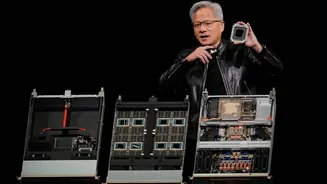
The surge in demand for computing power has reached extraordinary levels, with Jensen Huang noting an increase of approximately one million-fold within the last two years alone, and this trend shows no signs of slowing down. This unprecedented appetite for computational resources is directly fueling Nvidia's revenue growth. The company is at the forefront of developing and supplying the essential hardware needed to train and deploy sophisticated AI models. Huang elaborated on Nvidia's latest technological advancements, showcasing innovations in GPUs and integrated platforms designed to embed AI capabilities into a wide array of applications and systems. These advancements are crucial for everything from advanced robotics and smart applications to the data centers that manage global information flows, demonstrating Nvidia's pervasive influence across the technological spectrum.
AI Agents and Enterprise Strategy
The entire technology ecosystem, from established giants like OpenAI and Anthropic to emerging startups, is grappling with the challenge of scaling their AI initiatives, with a common bottleneck being the availability of sufficient computing capacity. Nvidia aims to address this by tailoring its technology for 'agentic' AI, which refers to AI systems capable of autonomous action and decision-making, as well as optimizing for both the training of AI models and inferencing – the process by which AI makes deductions or generates content. Demonstrations provided by the company highlighted these capabilities. Huang emphasized that every enterprise and software company globally must develop an 'AI agent strategy' to remain competitive. He envisions this evolving into a multi-trillion-dollar industry, moving beyond mere tools to specialized agents that can perform complex tasks. This strategic focus positions Nvidia as a key enabler for the widespread adoption of intelligent agents across diverse sectors, including automotive and healthcare.