





Beyond Sci-Fi Portals
The popular conception of wormholes as cosmic shortcuts, enabling interstellar travel or time machines, largely stems from a misinterpretation of groundbreaking
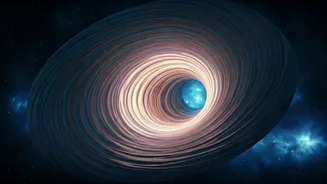
work by Albert Einstein and Nathan Rosen in 1935. Their focus wasn't on creating interstellar pathways but on understanding particle behavior under immense gravitational forces. The Einstein-Rosen bridge, a concept born from their research, describes a mathematical link between two identical, mirrored regions of spacetime. Its primary aim was to ensure consistency between Einstein's theory of general relativity and the burgeoning field of quantum physics, not to facilitate passage. The association with 'wormholes' as traversable tunnels emerged much later, diverging significantly from the original intent and leading to widespread misunderstanding.
Revisiting the Bridge
Recent scientific exploration revisits the Einstein-Rosen bridge concept, proposing it signifies something far more fundamental than a hypothetical spatial tunnel. This re-evaluation suggests the bridge acts as a mirror within spacetime, connecting two microscopic, opposing arrows of time. This interpretation arises from taking the symmetries inherent in fundamental physics laws seriously, particularly the indifference to the reversal of time or space. When infinities are removed from quantum evolution equations, the process must be complete and reversible at the quantum level, even with gravity present. The 'bridge' mathematically represents the necessity of both time directions for a comprehensive physical system description. While everyday experience favors a single forward arrow of time due to increasing entropy, quantum mechanics permits a more intricate structure.
Solving Paradoxes
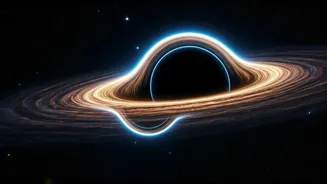
This dual-time-arrow interpretation offers a compelling solution to the long-standing black hole information paradox. This paradox, stemming from Stephen Hawking's 1974 discovery that black holes radiate and eventually evaporate, implies information loss, contradicting the quantum principle of information preservation. The paradox only arises when we force a description of event horizons using a single, infinitely extrapolated arrow of time. By incorporating both forward and backward temporal directions, the Einstein-Rosen bridge allows information to traverse what appears to be an event horizon, continuing its evolution in the reversed temporal direction without true loss. This framework upholds completeness and causality, negating the need for speculative new physics and demonstrating that nothing is truly lost within the universe.
Cosmic Echoes
Intriguingly, evidence for this hidden temporal structure may already be present in cosmic observations. The cosmic microwave background radiation, the relic heat from the Big Bang, exhibits a subtle asymmetry—a slight preference for one spatial orientation over its mirror image. This anomaly, puzzling cosmologists for two decades, is highly improbable within standard models but gains significance when mirror quantum components are considered. This observation hints at a deeper cosmic possibility: that the Big Bang was not an absolute beginning but a 'bounce.' In this scenario, black holes could act as temporal bridges between different cosmological epochs, with our universe possibly originating from the collapse and subsequent expansion of a 'parent' cosmos. Relics from this pre-bounce phase, like smaller black holes, might even persist as components of our universe's dark matter.