





Runaway Black Hole Discovery
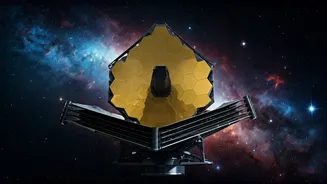
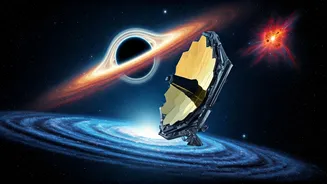
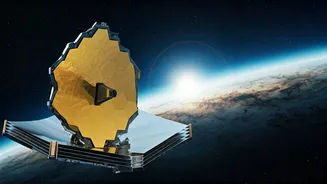
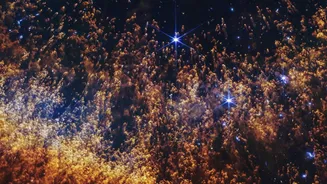
The James Webb Space Telescope has provided definitive confirmation of a supermassive black hole on a dramatic exodus from its host galaxy, hurtling through
space at an astonishing 2 million miles per hour. This observation challenges existing astrophysical models and suggests that such energetic galactic events, potentially triggered by the merger of three black holes, are more common than previously imagined. The black hole's spectacular flight path has created a luminous trail of newly forming stars in its wake, offering a unique, albeit destructive, stellar nursery. This phenomenon provides a rare glimpse into the violent dynamics that can occur at the centers of galaxies, forcing scientists to reconsider the processes that govern galactic evolution and the behavior of these cosmic behemoths.
The 'Sticky' Universe Hypothesis
Recent cosmological research proposes a radical re-evaluation of our universe's fundamental nature, suggesting it might behave more like a 'sticky' fluid than the empty expanse often depicted. This intriguing idea stems from observations that challenge the standard model of cosmology. If the universe possesses a degree of 'stickiness,' it could explain various puzzling phenomena that currently lack satisfactory explanations, such as the distribution of galaxies and the expansion rate of the universe. This fluid-like model offers a novel framework for understanding cosmic structures and their interactions, potentially bridging gaps in our knowledge that have persisted for decades. Further investigation is crucial to determine the validity and implications of this unconventional cosmological paradigm.
Planet Formation Clues
A remarkable discovery has unearthed what could be the crucial 'missing link' in our understanding of how planets are born. This finding sheds new light on the intricate processes that lead to the formation of planetary systems around stars. The observed phenomenon provides tangible evidence for intermediate stages in accretion disks that were previously only theoretical. By studying these nascent planetary building blocks, astronomers can refine models of planet formation, explaining variations in planetary system architectures and the prevalence of different types of planets. This breakthrough offers a more complete narrative of cosmic origin stories, from stellar nurseries to fully formed worlds.
Broiling 'Hell Planet'
The James Webb Space Telescope has detected an exoplanet with an atmospheric composition that defies current scientific understanding, leading astronomers to dub it a 'broiling hell planet.' This celestial body exhibits an atmosphere that theoretically should not exist under its observed conditions, presenting a profound mystery. The planet's extreme temperature and unusual atmospheric dynamics suggest novel chemical processes or interactions at play, pushing the boundaries of atmospheric science for exoplanets. Scientists are eager to analyze this data further to unravel the unique physics governing this enigmatic world, potentially leading to new theories about atmospheric evolution and stability in extreme cosmic environments.
Jupiter's Opposition Spectacle
This weekend offers an exceptional opportunity to witness Jupiter, the 'king of planets,' in its full glory as it reaches opposition. During this celestial event, Jupiter will be at its closest point to Earth and fully illuminated by the Sun, making it appear brighter than any other star in the night sky. This alignment allows for unparalleled viewing conditions, even with modest telescopes, providing stunning details of its iconic Great Red Spot and swirling cloud bands. Astronomers are also leveraging this period to conduct detailed observations, studying atmospheric phenomena and the planet's magnetic field with enhanced clarity. Observing Jupiter at opposition is a timeless astronomical treat for both seasoned stargazers and curious newcomers.
Cosmology Model Holds
A comprehensive, six-year study involving vast amounts of observational data has reaffirmed the robustness of the standard model of cosmology. Despite ongoing debates and the emergence of new cosmic puzzles, this extensive research indicates that our current framework for understanding the universe's origin, evolution, and large-scale structure remains remarkably accurate. The study meticulously analyzed cosmic microwave background radiation and large-scale structure distributions, finding no significant deviations that would necessitate a fundamental revision of the prevailing cosmological paradigm. While new discoveries continue to refine our knowledge, the standard model's enduring strength is a testament to its foundational principles.
Europa's Life-Friendly Molecules
Intriguing hints from Galileo mission images suggest that life-friendly molecules are escaping from Jupiter's massive moon, Europa. This discovery further bolsters the possibility of subsurface oceans teeming with life on this icy world. The detected molecular signatures point towards complex organic compounds being released from beneath Europa's frozen crust, potentially through plumes or other geological activity. Such findings are critical for future missions aimed at exploring Europa's habitability, as they provide direct evidence of the chemical ingredients necessary for life as we know it. The prospect of discovering extraterrestrial life within our own solar system has never seemed more tangible.
Planet Chasing Atmosphere
Astronomers using the JWST have identified a truly peculiar planet engaged in a unique cosmic chase: it appears to be pursuing its own atmosphere through the vastness of space. This extraordinary phenomenon, observed around the exoplanet, suggests an unusual atmospheric escape mechanism or a dynamic interaction with its stellar environment. The planet's atmosphere might be being stripped away by intense stellar winds, or perhaps the planet itself is moving through a dense cloud of its own ejected material. This discovery offers invaluable insights into atmospheric dynamics on exoplanets under extreme conditions and the complex interplay between stars and their planetary companions.
Primordial Tiny Black Holes
A fascinating hypothesis suggests that some celestial objects previously classified as planets might actually be incredibly small black holes formed during the universe's infancy. These 'primordial black holes' could represent remnants from the very early moments after the Big Bang, offering a direct window into the universe's most ancient epochs. If confirmed, this would revolutionize our understanding of early cosmic evolution and the nature of dark matter. Distinguishing these tiny black holes from actual planets requires sophisticated observational techniques, but their potential existence opens up entirely new avenues for astrophysical research into the universe's fundamental constituents.
Genetically Distinct Greek Region
A secluded region in Greece has been identified as harboring one of the most genetically distinct human populations in Europe. This unique genetic profile likely stems from a long history of relative isolation, allowing specific genetic markers to become more prevalent over generations. Studying such populations provides invaluable insights into human migration patterns, genetic adaptation, and the evolutionary history of our species. The distinctiveness of this group offers a living laboratory for understanding the complex interplay between geography, culture, and genetic diversity in shaping human populations across the continent.