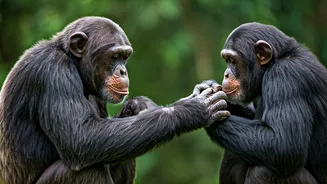







Social Bonds Explored
Recent studies have unveiled a captivating resemblance between the social lives of chimpanzees and bonobos and human social dynamics. Researchers, focusing
on primate social structures, observed that these primates, like humans, naturally form distinct social groups, effectively creating 'friend groups'. These groups go beyond simple associations, fostering significant bonds characterized by mutual support, coordinated activities, and clear preferences for certain individuals. The study underscores how these primates develop and maintain social connections, mirroring the complex networks we see within human societies. This supports the concept that social organization, with its inherent patterns and preferential affiliations, has ancient roots shared by humans and other primates.
Group Dynamics Analyzed
The research methods involved careful observation of chimpanzee and bonobo behavior. Scientists tracked interactions within these primate communities, noting the frequency and nature of social encounters. They meticulously analyzed how often individuals associated with each other, focusing on activities like grooming, playing, and sharing resources. By scrutinizing these interactions, researchers were able to identify consistent patterns of social preference and group formation, much like we see in human social settings. Such analysis enables the researchers to understand the characteristics and importance of these friend groups. Furthermore, the findings highlight that social ties among chimpanzees and bonobos are highly valuable for survival, cooperation, and overall well-being. These social dynamics are crucial in determining the survival of these species, highlighting their ability to navigate complex social landscapes.
Similarities to Humans
The parallels between primate and human social structures are genuinely remarkable. Like humans, chimpanzees and bonobos demonstrate clear preferences for specific individuals, forming close bonds. These relationships extend beyond mere convenience, often involving reciprocal altruism, protection, and emotional support. For instance, chimpanzees may support each other during conflicts, mirroring the alliances and friendships that exist in human social settings. The research emphasized how primates engage in coordinated activities within their groups, demonstrating similar behaviors to human groups. This includes activities such as hunting, defending territory, and sharing food, all of which require a degree of social cohesion and cooperation that is very comparable to what is observed in human communities. This study helps to understand social evolution, and the nature of social bonds is not unique to humans, but can be traced back to our primate ancestors.
Evolutionary Perspective
The discovery of friend groups within chimpanzee and bonobo populations provides significant clues about the evolution of human social behaviors. Researchers suggest that the complex social dynamics observed in these primates may have deep-rooted evolutionary origins. By studying the social structures of these primate species, scientists hope to gain valuable insights into the historical development of sociality in humans. The study also helps to understand the benefits of social bonds, such as enhanced survival prospects and increased cooperative behaviors, which can be traced back to our primate ancestors. This research underscores that sociality is a crucial element in our evolutionary history. Furthermore, it suggests that the ability to form strong social bonds has been advantageous for both chimpanzees, bonobos, and humans, enhancing their ability to thrive in social environments.