




Lunar Bound Journey
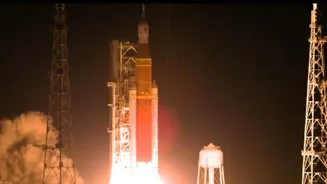
In a historic feat for space exploration, NASA's Artemis II mission successfully initiated its voyage beyond Earth's orbit. Approximately 25 hours post-launch,
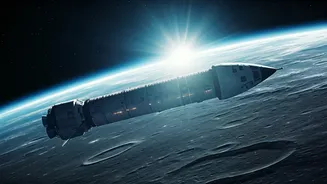
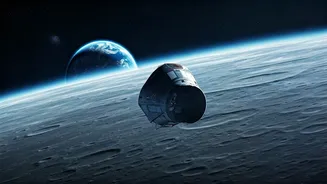
a crucial engine ignition propelled the Orion spacecraft and its four-person crew—three American astronauts and one Canadian—onto a trajectory aimed at the Moon. This maneuver, a testament to meticulous planning, signifies the first time humans have ventured beyond Earth's gravitational embrace since the Apollo 17 mission concluded in 1972. The crew, captivated by the receding view of our home planet, described the experience as awe-inspiring, underscoring a shared human drive for discovery. After initial system checks in Earth's orbit, the mission trajectory was confirmed, commencing a nearly 400,000-kilometer expedition into the void of deep space. This flight is not merely a return, but a bold stride towards establishing a lasting human footprint on the lunar surface, a long-held aspiration of NASA's lunar program.
Historic Crew & Records
The Artemis II crew is rewriting the narrative of space exploration. Commander Reid Wiseman, pilot Victor Glover, mission specialist Christina Koch, and Canadian astronaut Jeremy Hansen are embarking on a mission that breaks significant ground. For the first time, a Black astronaut (Glover), a woman (Koch), and a non-American (Hansen) are venturing to the Moon, marking a profound departure from the all-male, all-white crews of the Apollo era. Their journey will see them loop around the Moon without landing, but the mission is poised to shatter distance records. They are expected to travel further from Earth than any humans before, surpassing the previous record set by Apollo 13 in 1970. Furthermore, the Orion spacecraft's re-entry on April 10th could establish a new speed record. The sentiment surrounding the mission is one of "humanity's lunar homecoming," a phrase that encapsulates the significance of this return to lunar exploration and the diverse representation of humankind amongst the stars.
Mission Milestones & Challenges
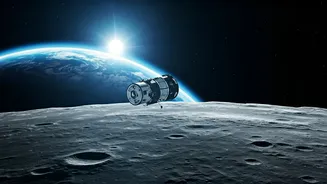
The Artemis II mission, while a triumph, has navigated its share of operational hurdles. The spacecraft is currently following a free-return trajectory, ingeniously utilizing the gravitational pull of both Earth and the Moon to complete its figure-eight path. The next major checkpoint is the lunar flyby, scheduled for Monday, where the Orion will pass an astonishing 6,400 kilometers beyond the Moon, offering unparalleled views of its far side. The astronauts are also anticipated to witness a total solar eclipse from an extraordinary vantage point in space. Despite these remarkable objectives, the crew has encountered minor issues, including a functional problem with the spacecraft's toilet system that required ingenious fixes, and cold cabin temperatures necessitating the use of thermal layers. Engineers also addressed a water dispenser issue by guiding the crew to utilize backup storage bags for drinking water. These challenges, though minor, highlight the complex realities of deep space travel and the ingenuity required to overcome them, all while paving the way for future crewed lunar landings.