






Unseen Communication Unveiled
In our increasingly digital existence, safeguarding information and finding innovative storage methods are paramount challenges. Fortunately, brilliant
minds globally are dedicated to pioneering solutions for these complex issues. A remarkable advancement has emerged from UNSW Sydney and Monash University, where researchers have engineered a system capable of concealing data transmissions within ordinary visual perception. This is achieved through a fascinating principle known as 'negative luminescence.' The outcome is a communication paradigm that is exceptionally resistant to hacking, not due to complex encryption, but because the very existence of a message is masked. The system operates by subtly embedding signals into the ambient thermal emissions that all objects continuously release – the kind of warmth often visualized by thermal imaging devices. From an external standpoint, the process appears completely inert, with only a specially equipped recipient able to discern and interpret the concealed data.
The Magic of Negative Luminescence
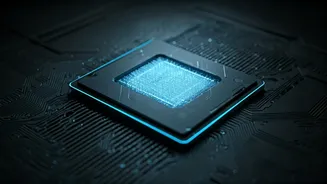
Every object in existence emits a subtle warmth, a faint glow detectable within the infrared spectrum. Negative luminescence, in essence, manipulates this inherent glow, making it appear darker rather than brighter. Dr. Michael Nielsen, a principal author from UNSW’s School of Photovoltaic and Renewable Energy Engineering, aptly describes this as akin to a 'flashlight that can go darker than off.' While this concept is paradoxical with visible light, certain materials possess the unique capability to manifest this phenomenon within the infrared wavelengths. The research team employs a specialized device known as a thermoradiative diode. This component is engineered to rapidly oscillate between emitting a brighter-than-usual signal and a dimmer-than-usual state. By orchestrating these rapid shifts, a pattern is generated that becomes indistinguishable from the background thermal noise, rendering the transmission completely imperceptible to anyone unaware of its active transmission.
Real-World Potential Explored
During controlled laboratory experiments, the research collective successfully demonstrated data transfer rates hovering around 100 kilobytes per second. While this initial speed is considered modest by contemporary standards, the researchers express confidence that this technology has the potential for significant acceleration. They envision future iterations reaching speeds in the gigabytes per second range as the emitter technology undergoes further refinement. Collaborators at Monash University have already put forth the idea of integrating graphene, a material known for its exceptional conductive properties, which could potentially propel these speeds to hundreds of gigabytes per second. Should these advancements be realized, it would fundamentally transform the landscape of secure data transmission, erect an almost insurmountable barrier against unauthorized access by malicious actors, and dramatically enhance the security of sensitive information.