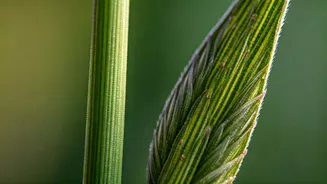







Stems: A Triangular Tale
At first glance, sedges and grasses might appear quite similar, both occupying lawns, meadows, and wetlands. However, a closer inspection reveals a fundamental
difference in their stem structure. While true grasses boast rounded, hollow stems, sedges are characterized by solid stems that are distinctly triangular in cross-section. This anatomical distinction is a primary identifier and reflects evolutionary divergences within the plant kingdom. Imagine holding a blade of grass versus a sedge stem; one would feel smooth and cylindrical, the other would have noticeable edges, akin to a miniature prism. This difference isn't just cosmetic; it can influence the plant's growth habit and its ability to withstand environmental pressures. The Cyperaceae family, to which sedges belong, has evolved these unique stems, setting them apart from the Poaceae family, the realm of true grasses.
Leaf Arrangement: A Matter of Ranks
Beyond the stem, the way leaves emerge from the plant provides another crucial clue for distinguishing sedges from their grass counterparts. True grasses typically display their leaves in two alternating ranks along the stem. If you were to visualize this, the leaves would appear to emerge from opposite sides of the stem, creating a simple, two-dimensional pattern. Sedges, on the other hand, exhibit a more complex arrangement, with their leaves emerging in three distinct ranks. This means that the leaves radiate outwards from the stem in a spiral or three-pointed fashion. This three-ranked leaf structure is a hallmark of the Cyperaceae family and is one of the most reliable ways to tell a sedge from a grass, especially when stems might be less distinct. This difference in leaf arrangement can also affect how sunlight is captured and how water is managed by the plant, contributing to their ecological niches.