




A Fiery World
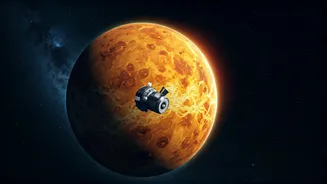
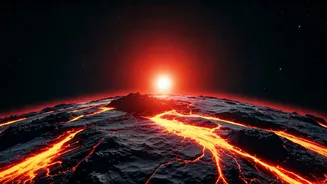
The James Webb Space Telescope (JWST) has identified a planet with an extremely high temperature, making it a 'hell planet'. This planet is notable not just
for its heat but also for the composition of its atmosphere, which presents a puzzle for scientists. The characteristics of this world are so peculiar that they challenge existing scientific models and have sparked considerable interest within the astronomical community. The discovery highlights the JWST’s ability to analyze exoplanets, opening up a new understanding of planetary atmospheres and their formation. Further investigation is needed to determine the precise details of the atmospheric makeup and the reasons for its existence in such an extreme environment. The observed atmospheric traits are not what would be predicted based on current understandings of planetary science and thermodynamics, hence the designation of 'mystery'.
Atmospheric Oddities
The atmosphere of the newly discovered hell planet is peculiar, and its unexpected composition has been a major surprise. This is a critical factor because the existing models don't easily explain the presence of some of the elements found there. Typically, planets of this kind are expected to exhibit a certain set of atmospheric characteristics. However, this particular planet deviates significantly from those norms. The elements and compounds detected in the atmosphere raise questions about how this planet formed and evolved. The JWST's data shows something scientists have not yet seen. The current atmospheric composition suggests unusual chemical reactions and atmospheric dynamics taking place. It's becoming increasingly clear that our understanding of planetary atmospheres needs to be refined. The specific details of the atmosphere's composition will be a focus of ongoing research.
Implications and Questions
The discovery of the 'hell planet' has a significant impact on our understanding of exoplanets and the methods used to study them. This finding pushes the boundaries of our knowledge, demonstrating that there is still much to learn about planetary science. The identification of unusual atmospheres forces scientists to rethink their current models and methodologies. There is a need to develop new theories. Further research will be crucial to understand these atmospheric conditions. The focus will be on the processes shaping planetary atmospheres in extreme environments. The data from the James Webb Space Telescope is expected to provide key insights. The planet serves as a unique case study, offering invaluable opportunities to enhance current theories. Scientists will seek to determine the planet's history and its role in the universe. Such explorations can provide valuable context to life elsewhere in the cosmos.
JWST’s Capabilities
The James Webb Space Telescope is capable of making such discoveries because of its advanced technology. The telescope can analyze the light that passes through exoplanet atmospheres. This ability allows scientists to identify the elements present, providing insight into the planetary environment. The telescope's sensitivity and precision are essential for observing these remote celestial bodies. The JWST’s instruments enable unprecedented studies of exoplanetary systems. This data is critical for understanding the compositions, thermal properties, and dynamics of distant planets. The telescope has the capability to analyze in detail. As the telescope continues its observations, the scientific community anticipates further exciting discoveries.
Future Research Directions
Future research on this 'hell planet' will focus on several key areas. Scientists will use the telescope’s observations to build detailed models. This will allow them to understand the processes shaping this atmosphere. One of the main goals will be to examine the atmospheric dynamics. The team will study how the planet's atmosphere interacts with stellar radiation. The researchers will also be looking into the planet's history, examining how it may have evolved and changed. The researchers will compare this planet's characteristics with those of other exoplanets. The information derived from the 'hell planet' will be instrumental in improving existing models and developing new ones. The planet is a laboratory for studying the processes that shape worlds.